
Get First 100 Email Subscribers No Audience: The Breakthrough

Want to get first 100 email subscribers with no audience, no ad budget, and no big website? Here’s the uncomfortable truth I wish someone had told me sooner: the problem was never your content. I spent months publishing posts nobody read, refreshing my subscriber count like it owed me money, watching it sit at a proud, lonely zero.
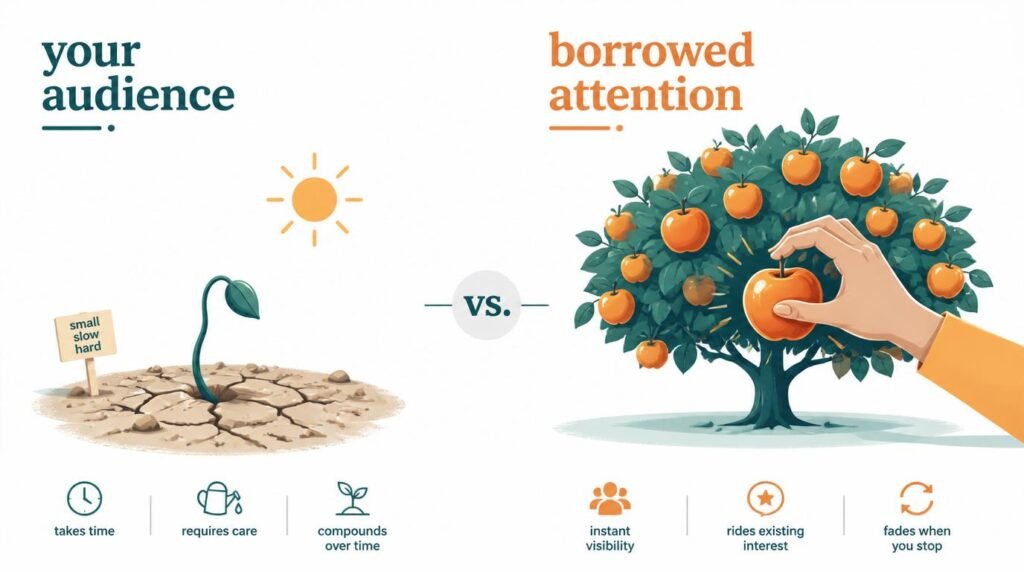
Every guide told me to “just create value,” as if value magically summons humans out of thin air. It doesn’t. What finally moved the needle had almost nothing to do with followers and everything to do with borrowing attention that already exists somewhere else. That single reframe took me from staring at an empty list to genuinely enjoying the process, and I’ll walk you through exactly how it works.
Table of Contents
- The Hidden Traffic Problem Behind Every Empty List
- The “Build It and They Will Come” Myth
- The One Asset That Beats Followers and Ads
- Where Your First 100 Subscribers Actually Come From
- The Borrowed-Audience Playbook (Advanced Tactics)
- The Mistakes That Kept Me Stuck at Zero
- Frequently Asked Questions
- My Top Recommended Gear
The Hidden Traffic Problem Behind Every Empty List
To get your first 100 email subscribers with no audience, skip the wait-for-traffic trap: put one specific lead magnet in front of people who already gather somewhere else, such as niche communities, other people’s newsletters, and podcast audiences, then send them to a single clean landing page. Borrowed attention beats a built audience every single time.
Why do so many list-building guides quietly ignore the one thing that actually decides your success? Because it isn’t glamorous. The real bottleneck for beginners isn’t your opt-in copy, your button color, or your headline. It’s that zero qualified humans ever reach your form in the first place. You can have the best signup box on the internet and still collect nothing if nobody sees it.
Here’s a number that reframes everything. Across form data studied by conversion researchers, a plain newsletter signup form converts at roughly 1.95% on average. That means even with traffic, only about two in a hundred visitors hand over an email. Now do the math with no traffic: two percent of zero is still zero. The lesson isn’t that opt-in forms are broken. It’s that traffic and offer have to arrive together, or nothing happens.
So why bother at all? Because the payoff is absurd once the list exists. Email consistently returns somewhere around $36 to $42 for every $1 spent, according to Litmus’s State of Email research, which routinely makes it the highest-return channel most small creators have access to. If you’re still shaky on the fundamentals, my walkthrough on how to do email marketing for beginners covers the groundwork before you ever chase that first subscriber. The asset is worth building. You just have to feed it differently than everyone tells you to.
The “Build It and They Will Come” Myth
Ever notice how the most repeated advice is also the most useless? “Create great content and people will find you” is the list-building equivalent of “just be yourself” before a job interview. Comforting, and almost entirely wrong for someone starting from zero.
Discovery algorithms are built to reward accounts that already have momentum. Your first hundred subscribers don’t come from a recommendation engine deciding to bless you. They come from search, from direct outreach, and from you deliberately placing yourself where interested people already stand. That’s it. The algorithm shows up later, after you’ve proven demand the manual way. Waiting for it to notice a brand-new, audience-free creator is like waiting for a bank to lend money to someone with no credit history: the system is designed to fund people who already have traction.
ngl, accepting this stung at first, because “post and pray” feels productive. But once I stopped treating publishing as a growth strategy and started treating it as a trust-builder, the whole thing clicked. Publishing earns trust from people who already found you. Something else has to do the finding.
The One Asset That Beats Followers and Ads
If I could hand my past self a single sticky note, it would say this: stop asking people to “subscribe” and start offering them a trade. This is the insider move that separates lists that grow from lists that flatline, and hardly anyone starting out gets it right.
Here’s the evidence that changed how I work. When MailerLite analyzed more than 41,000 signup forms, the average form paired with a real lead magnet converted at around 22%, with learning resources hitting 27.4% and checklists around 23%. Compare that to the roughly 2% a generic “join my newsletter” box earns, and you’re looking at a difference of more than 10x from the same number of eyeballs. That gap isn’t a rounding error. It’s the whole game.
Why does a trade work so much better than a request? Because “subscribe to my newsletter” asks the reader to bet on a vague future payoff, while “grab this checklist that fixes X in ten minutes” delivers a concrete win right now. People happily exchange an email for something immediately useful and specific. The best lead magnets share four traits: they’re specific, instant, genuinely valuable, and tied to whatever you eventually want to sell or write about. 🙂 Get those four right and your opt-in stops begging and starts trading.
Where Get First 100 Subscribers Actually Come From
So where do these people come from when you have no audience to draw on? Not from thin air, and not from luck. From five deliberate moves you can start today, no following required.
What should you offer before you ask for an email?
Start with the lead magnet from the last section. One page. One problem solved. If you sell nothing yet, pick the problem you’re most credible on and package the fastest possible fix. A recipe creator offers a one-week dinner plan; a freelance designer offers a five-point brand-checkup checklist. Specific always beats broad.
Where do you find people who already care?
Go where your reader already hangs out and talks: niche subreddits, focused Facebook groups, industry Slack and Discord servers, Quora threads, and old-school forums. These places are packed with people actively raising their hands about the exact problem your lead magnet solves. That’s borrowed attention, and it’s sitting there for free.
How do you show up without getting flagged as a spammer?
Give first, and give real value publicly before you ever mention your resource. Answer questions properly. Share the actual fix in the comment. Then, when it’s genuinely relevant, add “I put the full checklist here if it helps.” Communities punish takers and reward contributors, so earn the mention instead of grabbing it.
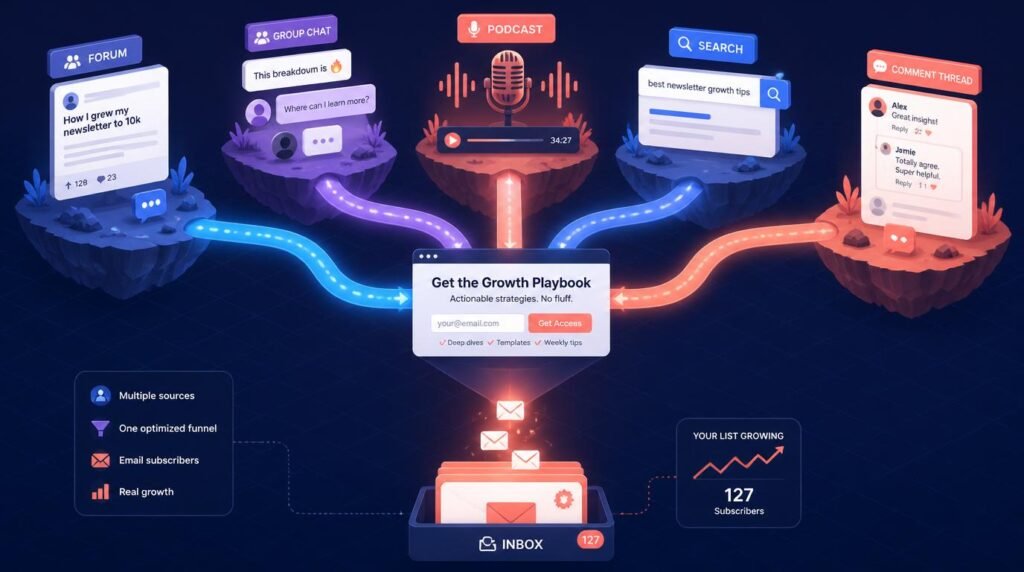
Where does the email actually get captured?
Every mention points to one place: a single, distraction-free landing page with one headline, a few benefit bullets, and a one-field email box. No navigation, no clutter, no competing links. Minimalist opt-in pages with well-matched traffic routinely convert far higher than a busy homepage, because the visitor’s only choice is yes or no.
What happens the moment someone subscribes?
Deliver the promised resource instantly and open the relationship with a warm, useful welcome message. This is where most beginners drop the ball, so I built a full template you can copy in my guide to the welcome email sequence for new subscribers. A subscriber who hears from you within minutes is a subscriber who actually remembers signing up.
Expert Commentary: Choose a video that walks through a real, from-zero list-building case study rather than generic “grow your list” advice, because watching someone place a lead magnet inside a specific community and show the resulting opt-ins is worth far more than another list of tips.
The Borrowed-Audience Playbook (Advanced Tactics)
Ready to go a level deeper than any beginner post usually dares? The fastest path to 100 isn’t scattering yourself across ten platforms. It’s plugging into audiences someone else already built and offering them something worth their attention.
Start with newsletter cross-promotions. Find creators roughly your size (not 100x bigger, or the trade won’t be fair) and swap recommendations, run a shared lead magnet, or mention each other’s opt-ins. You each put your offer in front of a warm, relevant list overnight. Next, chase podcast guesting. Small and mid-size shows are constantly hunting for guests, and a single episode with a clean “here’s my free checklist” call to action can send a wave of the right people to your page. Guest posting works the same way: one useful article on a site your reader already trusts, with a natural link to your lead magnet, borrows that site’s authority and traffic.
Then there’s the quiet powerhouse: becoming the most helpful answer in a community over and over. When you’re the person who reliably solves the problem, people click your profile, find your resource, and subscribe without you ever “pitching.” IMO this compounds better than any hack, because trust travels. Once your list crosses that first hundred, the smart move is to stop treating everyone identically and start grouping subscribers by interest so your emails stay relevant. My primer on powerful segmentation strategies for beginners shows how to set that up before your list gets unwieldy.
The Mistakes That Kept Me Stuck at Zero
Let me be honest about the months I wasted, because I don’t want you to repeat them. For a long stretch I did everything “right” and grew nothing, and the pattern of mistakes was almost embarrassing once I saw it laid out.
First, I asked for the subscribe before I offered the trade. Second, I spread myself so thin across platforms that I built presence nowhere. Third, and this is the one I want to save you from entirely, I got tempted by shortcuts. Buying or scraping email lists doesn’t just perform badly. It torches your sender reputation and can put you in direct violation of the law. The FTC’s CAN-SPAM compliance guide spells out real penalties for sending commercial email to people who never opted in, so a “shortcut” list can cost far more than it ever earns.
The version of you that reaches 100 real subscribers isn’t the one who found a clever trick. It’s the one who kept showing up in the right rooms, kept trading real value for attention, and refused to fake growth. That person builds an asset that pays for years. The shortcut-taker keeps starting over. You already know which one you’d rather be.

Frequently Asked Questions
How long does it take to get your first 100 email subscribers with no audience?
With consistent effort, most beginners reach 100 subscribers in 30 to 90 days. Speed depends on how sharp your lead magnet is and how many active communities you show up in. Two or three focused promotion channels beat ten half-hearted ones.
Do I need a website to build an email list?
No. A single landing page from a free tool is enough. Your first 100 subscribers care about your offer, not your homepage. You can add a full website later, once the list is already growing.
What is the best lead magnet for beginners with no audience?
A short, specific resource that solves one urgent problem, such as a checklist, template, or mini-guide. MailerLite’s analysis of more than 41,000 forms found that learning resources and checklists convert far better than a plain join-my-newsletter ask.
Is it okay to buy an email list to reach 100 subscribers faster?
No. Bought lists wreck your deliverability, burn your sender reputation, and can put you on the wrong side of the FTC’s CAN-SPAM rules. A hundred people who opted in are worth more than a thousand strangers who never asked to hear from you.
Which free email tool should I use to start?
Beginner-friendly platforms like MailerLite, Kit, and Beehiiv all offer free plans that cover a landing page, signup forms, and automated welcome emails, which is everything you need for your first 100 subscribers.
My Top Recommended Gear
The Adweek Copywriting Handbook — The clearest book I know for writing lead-magnet titles and opt-in copy that actually gets clicked. Check it on Amazon.
A USB Podcast Microphone — If podcast guesting and audio lead magnets are part of your borrowed-audience plan, clean sound makes you sound credible on day one. Check it on Amazon.
A Clip-On Ring Light — For turning a quick tutorial into a video lead magnet or a guest appearance that looks polished, a simple ring light punches above its price. Check it on Amazon.
Disclaimer: This post contains affiliate links. As an Amazon Associate, I may earn a commission from qualifying purchases at no additional cost to you. I only recommend products I’ve personally tested or rigorously researched.