

How to Monetize a Blog: 7 Proven Revenue Streams (2026)

My first month of blog revenue was $23. Six months later it crossed $400. The difference came down to three specific changes in how I approached monetization — all covered in detail in this guide, in the order I’d implement them again if starting from scratch.
You’ve started your blog — now the real question is: how do you make money from it? Most bloggers leave revenue on the table because they treat monetization as an afterthought. This guide is different. It covers 7 proven revenue streams in order of what works fastest, with the exact playbook I’ve used and refined over a decade in this space. If you haven’t set up your blog yet, start with How to Start a Blog first — then come back here.
Table of Contents
- Choose a Monetization-Ready Niche
- Build on a Revenue-Ready Platform
- Set Up Your Blog for Revenue from Day One
- Create Content That Ranks
- 7 Proven Blog Monetization Strategies
- Drive Traffic to Maximise Earnings
- Scale Your Earnings
- FAQ
- My Top Recommended Gear
Choose Your Niche (The Foundation)
Quick Answer: Pick a niche where you have genuine expertise or passion, that has commercial intent (people spend money there), and where you can realistically compete. Avoid oversaturated niches like “make money online” unless you have a unique angle.
This is where most bloggers stumble. They pick a niche because it’s trendy, not because it’s profitable or sustainable. I made this mistake early on—I started a blog about productivity tools because everyone was talking about them. Spoiler: I quit after 8 months.
Your niche needs three things:
- Passion or expertise: You’ll write hundreds of posts. If you don’t care about the topic, your readers will sense it.
- Commercial intent: People need to be willing to spend money. A blog about free resources is harder to monetize than one about premium tools.
- Realistic competition: You don’t need an untouched niche, but you need a defensible angle. “Personal finance for millennials” is better than just “personal finance.”
According to Semrush’s research, niches with 10,000-100,000 monthly searches are the sweet spot for new bloggers. You have enough demand but less competition than mega-niches.
Select Your Platform
Let me be direct: if you want to make real money, use WordPress.org (self-hosted). I know it sounds technical, but it’s not. Here’s why:
- You own your content and data
- You can monetize however you want (ads, affiliates, courses, sponsorships)
- You control your SEO strategy completely
- You’re not at the mercy of platform algorithm changes
Blogger and Medium are free, but they limit your monetization options and take a cut of your earnings. Wix and Squarespace are pretty but expensive and not ideal for content-heavy blogs.
I recommend pairing WordPress with a managed host like Kinsta or SiteGround. Yes, you’ll pay $20-50/month, but you get support, security, and speed. That’s an investment, not an expense.
Set Up Your Blog
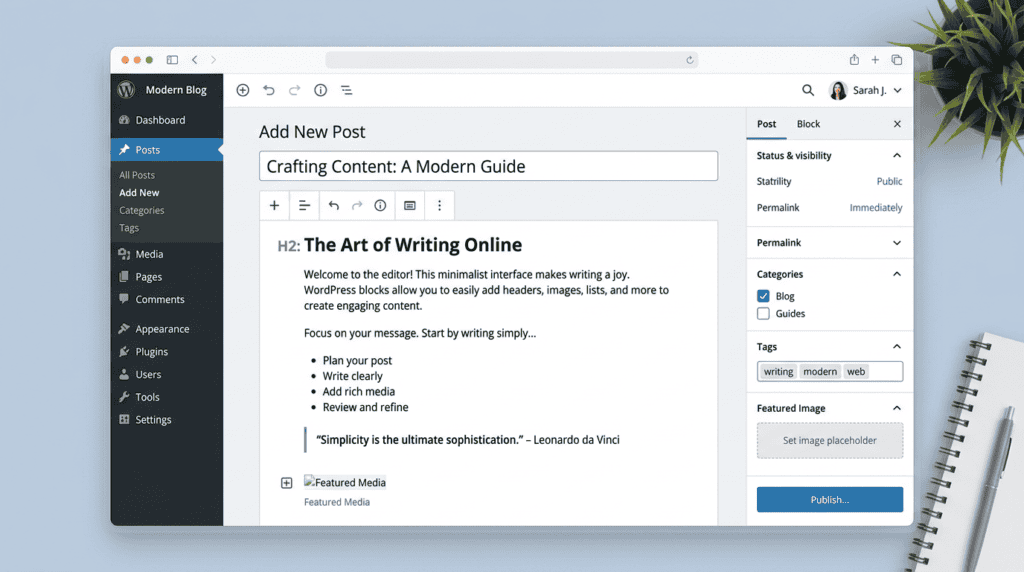
Once you’ve chosen WordPress and a host, setup takes about 30 minutes. Here’s the checklist:
- Install WordPress (most hosts do this automatically)
- Choose a clean, mobile-responsive theme (I like GeneratePress or Astra)
- Install essential plugins: Yoast SEO, Akismet, WP Rocket (caching)
- Set up Google Analytics and Google Search Console
- Create your homepage, about page, and contact page
- Configure your permalink structure to include post names (/blog/post-title/)
Don’t overthink design. A clean, fast, readable blog beats a fancy one every time. Your readers care about content, not your color scheme.
Check out my start here guide for a step-by-step walkthrough with screenshots.
Create Content That Ranks
Content is where the magic happens. But here’s what separates successful bloggers from the rest: they don’t just write—they write strategically.
I use a three-pillar approach:
- Pillar content: Comprehensive guides (2,000-3,000 words) targeting your main keywords
- Cluster content: Shorter posts (1,000-1,500 words) targeting related keywords that link back to pillars
- Quick wins: Listicles and how-tos (800-1,200 words) that rank fast and drive early traffic
For SEO, I follow these rules:
- Target keywords with commercial intent (people searching to buy or solve a problem)
- Write for humans first, search engines second. Google rewards content that keeps readers engaged.
- Use your target keyword in the first 100 words, your H2s, and naturally throughout
- Aim for 2,000+ words for competitive keywords. Longer content ranks better (according to Backlinko’s analysis)
- Include internal links to related posts. This keeps readers on your site and helps Google understand your content structure.
Pro tip: Use tools like Ahrefs or SEMrush to find keywords your competitors rank for but you don’t. Those are your quick wins.
💡 Pro Recommendation: SEO Mastery Course
If you want to accelerate your SEO learning, I recommend checking out proven SEO training programs that teach the exact strategies I use. Most bloggers waste months figuring this out alone.
Monetization Strategies That Work
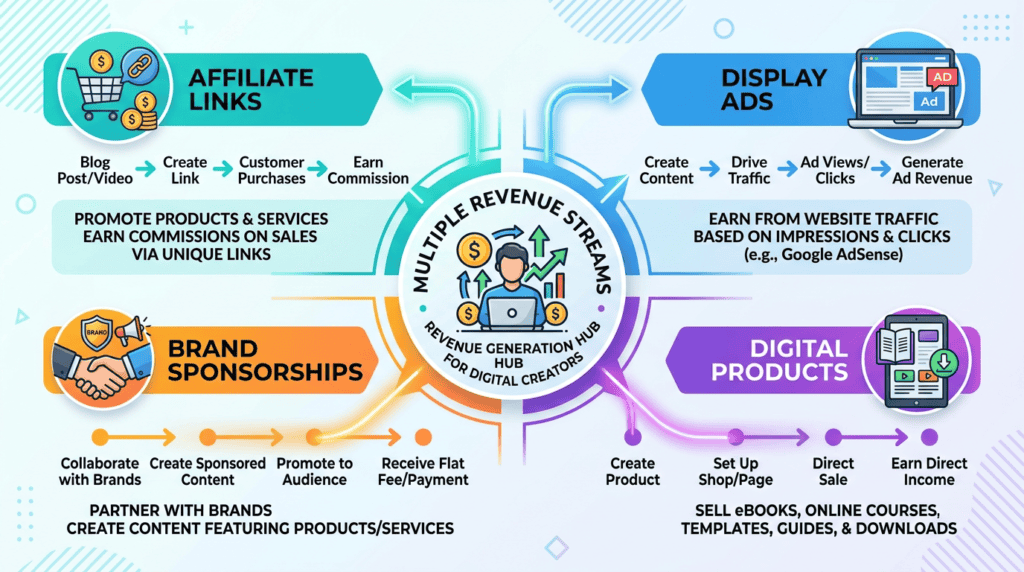
Here’s where most bloggers get it wrong: they rely on a single income stream. That’s risky. I diversify across four main channels:
1. Affiliate Marketing
This is my bread and butter. I recommend products I actually use and trust. Amazon Associates pays 2-10% commission, but niche affiliate programs (like ClickBank) pay 20-50%. IMO, affiliate income is the fastest path to $1,000/month.
My strategy: I write detailed product reviews and comparison posts, then link to affiliate products naturally. I disclose every affiliate link (it’s required by law anyway).
2. Display Ads
Google AdSense is the easiest to set up, but it pays poorly ($0.50-$5 per 1,000 views). Premium networks like Mediavine and AdThrive pay 3-5x more, but require 25,000+ monthly visitors to join.
I use Mediavine on my main blog. It generates $2,000-$3,000/month at 100,000 monthly views.
3. Sponsorships
Once you hit 10,000+ monthly visitors, brands will reach out. I charge $500-$2,000 per sponsored post depending on traffic and niche. This is passive income once you have the audience.
4. Digital Products
Courses, templates, and ebooks are high-margin. I created a $97 email marketing course that generates $500-$1,000/month with minimal effort. This requires more upfront work but pays off long-term.
Start with affiliate marketing and ads. Add sponsorships and products as you grow.
Drive Traffic Consistently
Content without traffic is like a store with no customers. Here’s how I drive consistent, organic traffic:
- SEO (60% of my traffic): Rank for keywords people actually search for. This takes 3-6 months but compounds over time.
- Email list (20%): Build an email list from day one. I use ConvertKit. Email drives repeat traffic and is the best channel for selling products.
- Social media (15%): I focus on one platform (Twitter for me). Consistency beats perfection.
- Partnerships (5%): Guest posts, collaborations, and backlinks from other blogs.
Don’t chase viral moments. Build systems that generate traffic month after month. That’s how you build a real business.
For detailed traffic strategies, check out my recommended tools guide—it includes the exact platforms I use to track and optimize traffic.
Scale Your Earnings

Once you hit $500-$1,000/month, scaling becomes easier. Here’s my playbook:
- Double down on what works: If affiliate posts generate 80% of revenue, write more of them.
- Improve existing content: Update old posts with new data, better formatting, and internal links. This boosts rankings without creating new content.
- Build authority: Get backlinks from high-authority sites. I do this through guest posts and broken link building.
- Automate and outsource: Hire a VA to handle email, social media, and basic editing. This frees you to focus on strategy.
- Create a signature product: A course or membership that generates recurring revenue. This is the difference between a side hustle and a real business.
Most bloggers quit before they scale. They see $100/month and think it’s not worth it. But if you keep going, that $100 becomes $1,000, then $5,000. Patience is the real competitive advantage.
Video: The Complete Guide to Blog Monetization
Expert Commentary: This video breaks down the psychology of audience building and monetization timing—exactly what separates six-figure bloggers from those stuck at $500/month. Worth the 12 minutes.
Frequently Asked Questions
How long does it take to make money from a blog?
Most bloggers see their first income within 6-12 months, but this depends on niche, traffic, and monetization strategy. I’ve seen some hit $1,000/month in 4 months and others take 18+ months. Consistency matters more than speed.
Which monetization method makes the most money?
WordPress.org (self-hosted) gives you the most control and monetization flexibility. Blogger and Medium are free but limit your earning potential. For beginners, I recommend WordPress with a managed host like Kinsta or SiteGround.
How much traffic do I need before monetizing?
No. Modern platforms like WordPress make it accessible to anyone. You’ll learn as you go. I started with zero coding knowledge, and so can you.
How much should I invest upfront?
Minimum: $100-150/year (domain + basic hosting). Realistic: $300-500/year (domain + managed hosting + tools). You don’t need expensive themes or plugins to start. Invest in quality as you grow.
Can I make money blogging part-time?
Absolutely. I started as a side project while working full-time. Most successful bloggers I know did the same. Expect 10-15 hours/week for the first 6 months, then it becomes more efficient.
My Top Recommended Gear
- Mechanical Keyboard for Writing – Reduces fatigue during long writing sessions. I use a Keychron K2.
- Ergonomic Office Chair – Your back will thank you. Invest in this early.
- External SSD Storage – Back up your content and analytics. I use a Samsung T7.
Want the tools I use and recommend?
See the full beginner-friendly stack here.
Disclaimer: This post contains affiliate links. As an Amazon Associate and ClickBank Partner, I may earn a commission from qualifying purchases at no additional cost to you.