

Underrated AI Writing Tools for Bloggers to Try

Most lists about AI writing tools for bloggers recycle the same three or four names — ChatGPT, Jasper, Copy.ai — and call it a day. Here’s the problem: everyone and their dog already uses those. Your competitors use them. Their competitors use them. The output starts sounding eerily similar across entire niches, and Google’s getting better at spotting that homogenized mush every single quarter.
That sameness agitates me because I’ve spent over a decade building content strategies, and I know firsthand that the edge rarely comes from the tool everyone already talks about. It comes from the one nobody’s covering yet. So I went deep — tested over 20 lesser-known AI blogging software platforms over six months, burned through trial plans, lifetime deals, and a few tools that made me want to throw my laptop. What survived that gauntlet? The genuinely useful, criminally overlooked blogging tools I’m about to share with you.
Table of Contents
- What Actually Makes an AI Writing Tool “Underrated”?
- The Underrated AI Writing Tools Worth Your Time
- Myth-Busting: What AI Blogging Tools Can’t Do
- Advanced Tactics: How I Stack These Tools for 10x Output
- The SEO Angle Most Bloggers Completely Miss
- FAQ
- My Top Recommended Gear
What Actually Makes an AI Writing Tool “Underrated”?
An underrated AI writing tool for bloggers is one that delivers professional-grade content assistance — including SEO optimization, tone control, and long-form generation — but hasn’t yet gained mainstream recognition due to limited marketing budgets or niche positioning, despite rivaling or outperforming popular alternatives.
I want to be precise here because “underrated” gets thrown around loosely. I’m not talking about tools that are bad and deservedly unknown. I’m talking about AI content writing platforms that genuinely solve problems better than the big names in specific areas but fly under the radar because they don’t have a $50 million marketing budget.
My criteria for this list came down to four non-negotiable factors:
- Output quality: Can it produce content I’d actually publish after light editing, not a full rewrite?
- Blogger-specific features: Does it understand blog structure, SEO writing, internal linking, and content flow — or does it just spit out generic copy?
- Price-to-value ratio: Is it priced fairly for what independent bloggers and small teams can afford?
- Unique angle: Does it do at least one thing that ChatGPT or Jasper can’t do as well out of the box?
If you’re just starting your blogging journey and want a broader foundation, I’ve put together a Start Here guide that covers the essentials before you layer on advanced tools.
The Underrated AI Writing Tools Worth Your Time
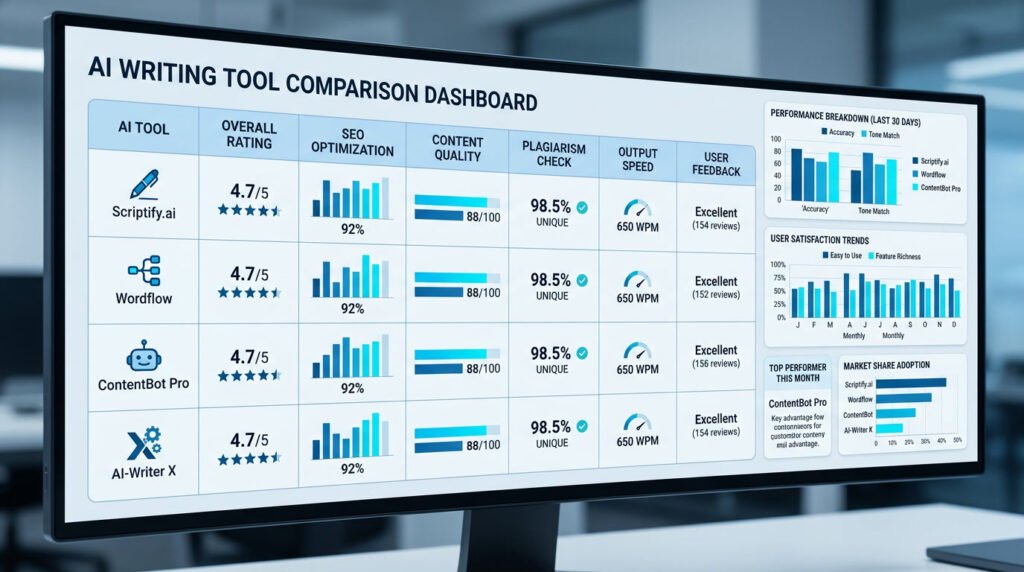
1. Moonbeam — The Long-Form Specialist
Moonbeam doesn’t try to be everything. It focuses exclusively on long-form blog content, and it does it shockingly well. I fed it a 2,000-word brief on a technical SEO topic, and the first draft came back with proper H2/H3 hierarchy, transition sentences that didn’t make me cringe, and — here’s the kicker — it naturally wove in contextual examples without me prompting for them.
Most blogger tools generate flat, listicle-style content. Moonbeam generates structured arguments. For serious bloggers writing thought-leadership content, this is a massive differentiator.
2. Cohesive AI — The All-in-One Nobody Talks About
Cohesive gives you a full content workspace: writing, editing, SEO scoring, brand voice profiles, and even image generation — all in one tab. I stumbled across it on a random Product Hunt thread and honestly thought it was too good to be true. After three months of use, I can confirm it’s legit. The brand voice feature alone saves me from spending 20 minutes re-editing tone on every piece.
3. Rytr — Budget King With Surprising Depth
Rytr often gets dismissed as a “cheap alternative.” That’s a mistake. Its use-case templates for blog intros, outlines, and meta descriptions rival tools costing 5x more. I use it specifically for generating 10–15 blog title variations when I’m stuck. The quality-to-cost ratio is, IMO, the best in the entire content creation tool market right now.
4. WordHero — Lifetime Deal Legend
If you grabbed WordHero’s lifetime deal on AppSumo, you already know. If you didn’t, it’s still worth its monthly price. WordHero handles short-form and mid-form blog content with a refreshingly simple interface. No bloat, no ten-step wizards — just type your topic, pick a mode, and go. It’s the tool I hand to clients who find Jasper overwhelming.
5. Writesonic (Chatsonic Mode)
Yes, Writesonic itself isn’t unknown. But its Chatsonic feature — which connects to real-time Google search data — remains massively underutilized by bloggers. I use Chatsonic to draft content that references current statistics and recent news, something standard LLMs struggle with due to training data cutoffs. According to research from Stanford’s Human-Centered AI Institute, real-time data integration represents one of the most significant leaps in AI utility for content professionals.
For a more comprehensive roundup including mainstream options, check out my best AI tools for bloggers guide.
Myth-Busting: What AI Blogging Tools Can’t Do
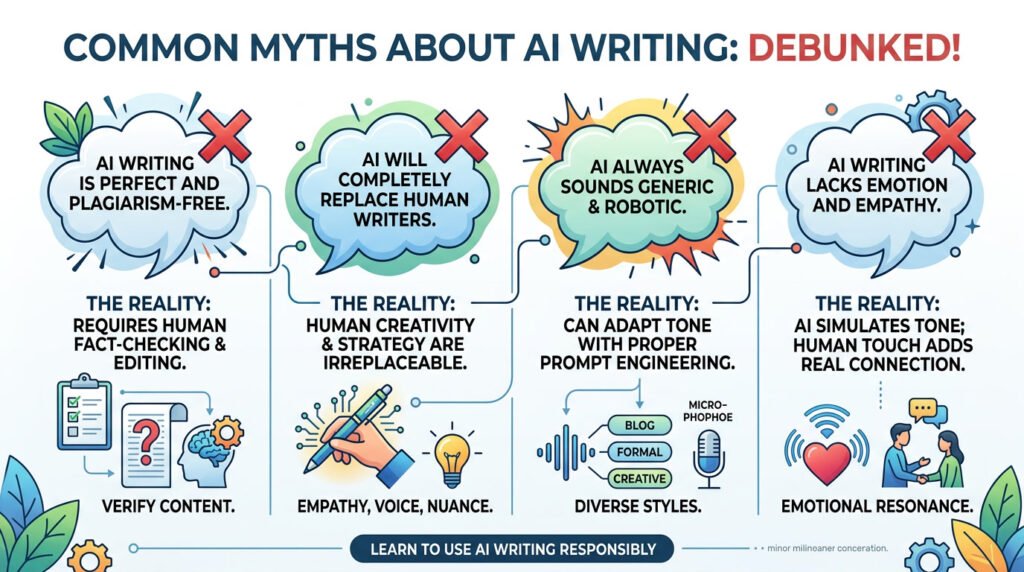
Let me kill a few sacred cows here because the AI hype machine has bloggers believing some seriously dangerous nonsense.
Myth #1: “AI tools will write your entire blog for you.”
No, they won’t — not if you want content that ranks and converts. Google’s own guidance on AI content makes it clear: they reward helpful content, period. An AI draft without your expertise, your stories, and your editorial judgment is just another thin article that’ll get buried on page 7.
Myth #2: “The most expensive tool produces the best content.”
I’ve seen $15/month tools outperform $99/month platforms on specific tasks. The tool doesn’t determine quality — your prompt engineering and editorial process does. A $200/month AI subscription feeding sloppy prompts produces worse output than Rytr feeding well-crafted briefs. Every. Single. Time.
Myth #3: “AI content is automatically penalized by Google.”
This one refuses to die. Google has explicitly stated it does not penalize content for being AI-generated. It penalizes content for being unhelpful, spammy, or manipulative — regardless of who or what wrote it. The FTC has also weighed in on AI marketing claims, emphasizing transparency over blanket prohibition.
Advanced Tactics: How I Stack These Tools for 10x Output
Here’s where it gets fun. I don’t use one AI writing tool — I stack them. Here’s my actual workflow for a 2,000-word blog post:
- Step 1 — Research with Chatsonic: I pull real-time data, recent stats, and trending subtopics. This gives me a factual backbone no static-model tool can match.
- Step 2 — Outline with Moonbeam: I feed the research into Moonbeam and let it generate a structured, argument-driven outline. I spend 10 minutes refining it.
- Step 3 — Draft sections with Cohesive AI: Using my brand voice profile, I generate each H2 section individually. This keeps tone consistent and prevents the “AI fatigue” you see in one-shot drafts.
- Step 4 — SEO polish with Surfer or Clearscope: I run the draft through dedicated blog SEO tools to check keyword density, NLP terms, and content score against top-ranking competitors.
- Step 5 — Human edit: This is non-negotiable. I rewrite intros, inject personal anecdotes, fact-check every claim, and add internal links. This is where the post becomes mine.
This stacked approach lets me produce 3–4 high-quality posts per week instead of one. That’s not a marginal improvement — it’s a fundamental shift in content creation capacity 🙂
I keep an updated list of every tool in my stack on my recommended tools page if you want the full breakdown.
Expert Commentary: This video provides an excellent, no-hype walkthrough of how working bloggers actually integrate AI tools into their daily workflow — skip the theory and watch someone do it in real time.
The SEO Angle Most Bloggers Completely Miss
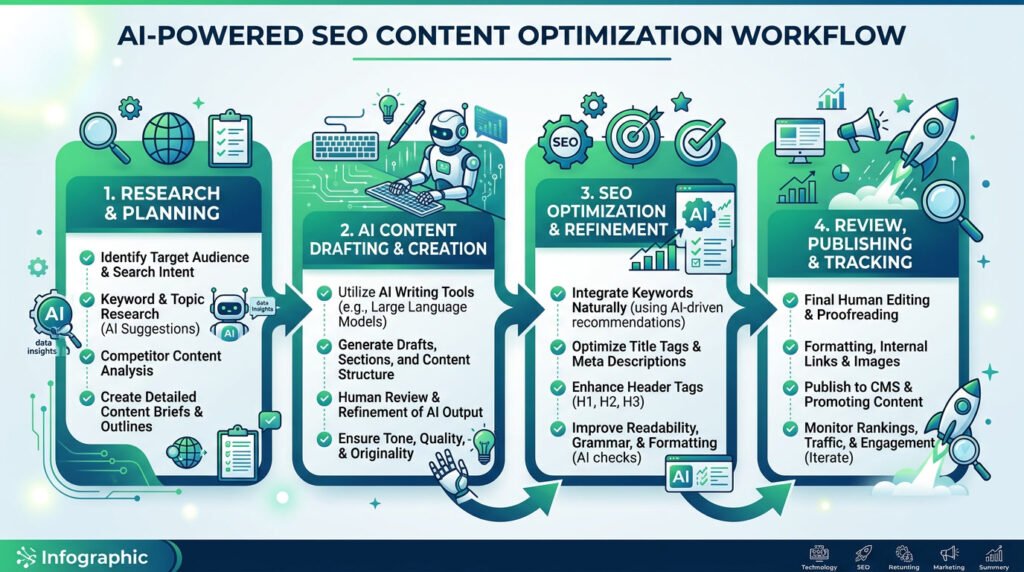
Here’s something I almost never see discussed: most bloggers use AI writing tools for bloggers to generate body content and completely ignore the meta layer. That’s leaving rankings on the table.
I use AI tools aggressively for:
- Title tag variations: Generate 20 options, A/B test the best 2 with click-through data.
- Meta descriptions: Rytr cranks out 10 meta descriptions in 30 seconds. I pick the one with the strongest call-to-action verb.
- Schema markup generation: Cohesive AI can generate FAQPage and HowTo schema from my content with minimal prompting. That’s free rich result real estate.
- Internal link suggestions: I paste my sitemap context into Chatsonic and ask it to suggest relevant internal links for any draft. It catches connections I miss, especially on sites with 200+ posts.
The bloggers who treat SEO writing as a post-production checklist instead of embedding it into their AI workflow are fighting with one hand tied behind their back. Don’t be that blogger.
Also — and I can’t stress this enough — Google’s Search Quality Evaluator Guidelines make it crystal clear that E-E-A-T (Experience, Expertise, Authoritativeness, Trustworthiness) matters more than ever. Your AI tool provides efficiency. You provide the E-E-A-T. That combination is what actually wins in 2025.
FAQ
What are the best underrated AI writing tools for bloggers?
Some of the best underrated AI writing tools for bloggers include Moonbeam (for long-form structure), Cohesive AI (for all-in-one workflows), Rytr (for budget-friendly quality), WordHero (for simplicity), and Writesonic’s Chatsonic mode (for real-time data integration). Each excels in areas where mainstream tools fall short.
Can AI writing tools fully replace human bloggers?
No — and anyone telling you otherwise is selling something. AI content writing tools accelerate drafting, research, and optimization, but they cannot replicate genuine personal experience, nuanced critical thinking, or authentic voice. The winning formula combines AI speed with human editorial depth. Period.
Are AI-generated blog posts bad for SEO?
Not inherently. Google rewards helpful content regardless of production method. However, unedited AI output often lacks the depth, originality, and E-E-A-T signals needed to rank competitively. Use AI as your first draft engine, not your publish button. That’s the approach that works with modern blog SEO tools and ranking algorithms.
How much do AI blogging software tools typically cost?
Most AI blogging software ranges from free tiers (with limited word counts) to $20–$100/month for professional plans. Lifetime deals on platforms like AppSumo can drop costs dramatically. My advice? Start with a free tier, test the output against your specific niche, and upgrade only when you’ve confirmed it genuinely saves you time. Don’t pay for features you’ll never touch tbh.
My Top Recommended Gear
Beyond software, the right hardware and resources make a measurable difference in your blogging workflow. Here are three picks I personally use and recommend:
- Mechanical Keyboard for Writers — Sounds trivial until you’re 3,000 words deep and your fingers are screaming. A solid mechanical keyboard with tactile switches transformed my typing endurance. Not kidding.
- Ultrawide Monitor for Content Creators — Running your AI tool, SEO scorer, and draft side-by-side on a single ultrawide eliminates the tab-switching chaos. My productivity jumped noticeably within the first week.
- Noise-Cancelling Headphones for Remote Work — If you blog from home (or a coffee shop, or anywhere with ambient noise), these aren’t a luxury — they’re a necessity for deep-focus writing sessions.
Disclaimer: This post contains affiliate links. As an Amazon Associate, I may earn a commission from qualifying purchases at no additional cost to you.