

Affiliate Marketing for Bloggers: Proven Growth Hacks That Actually Work

My first affiliate commission was $4.50. My first $1,000 month took 14 months. I share both numbers because most affiliate guides skip the timeline reality. The strategies here are what actually moved the needle for me — and what I still use today.
Affiliate marketing for bloggers sounds like a dream — write a post, drop a link, collect checks while you sleep. But here’s the ugly truth: most bloggers who try affiliate marketing earn less than their monthly coffee budget. The problem isn’t the model; it’s the execution. I’ve spent over a decade building affiliate-driven blogs, and I’ve watched hundreds of smart people fail because they followed recycled advice from people who’ve never actually ranked a page or earned a real commission. The frustration compounds when months of effort yield single-digit clicks and zero sales. The solution? Stop guessing. Start deploying the affiliate blogging strategies that top earners use but rarely share publicly. That’s exactly what I’m laying out for you right now.
Table of Contents
- What Is Affiliate Marketing for Bloggers (And Why Most Get It Wrong)?
- Myth-Busting: The Lies Nobody Tells You
- Choosing Affiliate Programs Like a Pro
- The Content Strategy That Prints Money
- Advanced Tactics: Where Real Blog Income Lives
- Conversion Optimization: Turning Clicks Into Commissions
- FAQ: Affiliate Marketing for Bloggers
- My Top Recommended Gear
What Is Affiliate Marketing for Bloggers (And Why Most Get It Wrong)?
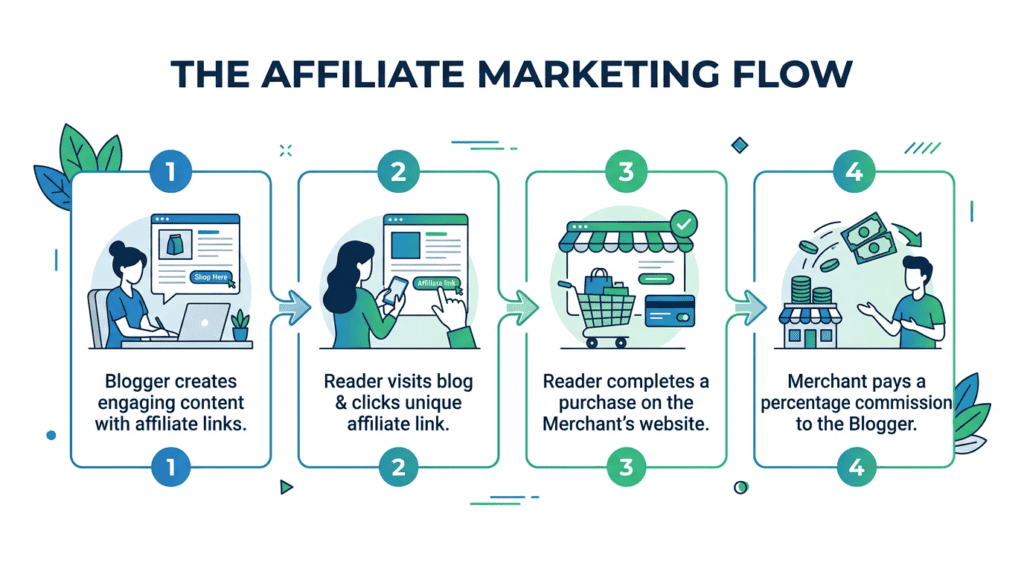
Affiliate marketing for bloggers is a performance-based monetization strategy where you earn commissions by recommending products or services through tracked links within your blog content. It works when you match genuine reader intent with relevant offers, creating value for all three parties: the reader, the merchant, and you. The key differentiator between bloggers who earn $50 per month and those earning $50,000 is understanding search intent and strategic content placement.
Here’s what I wish someone had told me in 2014 when I placed my first affiliate link in a rambling 400-word post and waited for the money to roll in (spoiler: it didn’t). Blogging for money through affiliates isn’t about stuffing links into random content. It’s about engineering content specifically designed to meet a reader at the exact moment they’re ready to buy — or at least ready to seriously consider buying.
The Federal Trade Commission (FTC) requires full disclosure of affiliate relationships, and honestly, transparency isn’t just a legal obligation — it’s a trust accelerator. I’ve seen my conversion rates increase after adding clear disclosures. Readers aren’t stupid. They appreciate honesty. If you’re new to this entire game and need a structured starting point, I’ve built a comprehensive beginner’s roadmap right here that walks you through the fundamentals.
Myth-Busting: The Lies Nobody Tells You
Let me dismantle some myths that keep smart bloggers broke:
Myth #1: “You need massive traffic to make affiliate income.” False. I’ve managed micro-niche blogs with 5,000 monthly sessions that outearned sites with 100,000+ visits. Why? Buyer-intent keywords. A thousand people searching “what is a standing desk” are worth far less than fifty people searching “best standing desk under $500 for home office.” Intent is everything.
Myth #2: “More affiliate links = more money.” This is the fastest way to tank your rankings AND your reader trust simultaneously. Google’s helpful content guidelines explicitly penalize content that exists primarily to funnel clicks. I keep my affiliate link density to 3–5 contextual placements per 1,500-word post, max.
Myth #3: “Passive income means no maintenance.” IMO, this is the most dangerous myth. Every successful affiliate post I’ve ever published requires quarterly updates — refreshed product information, updated pricing, new competitor comparisons. Passive income blogging is really “less active” income. It still demands attention, just on a different schedule.
Choosing Affiliate Programs Like a Pro
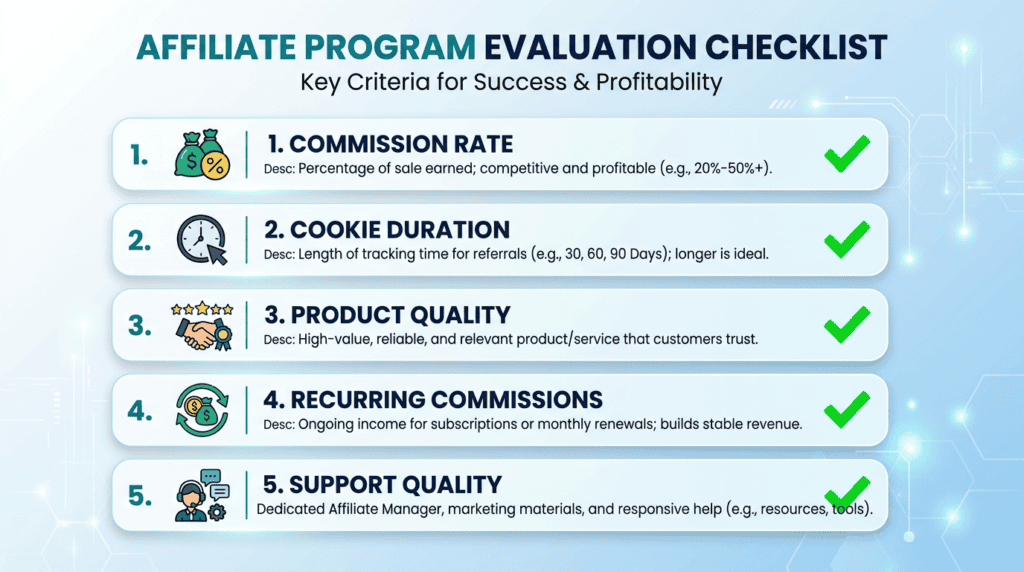
Here’s my actual framework for evaluating affiliate programs — the same one I use before signing up for anything:
- Commission Rate vs. Conversion Rate: A 3% commission on a product that converts at 15% will outperform an 80% commission on something that converts at 0.2%. I always request (or research) conversion data before promoting anything.
- Cookie Duration: Anything under 30 days makes me skeptical. Amazon’s notorious 24-hour cookie works purely because of their absurd conversion rates and cart additions. For everything else, I want 30–90 days minimum.
- Product Quality: Have I used it, or can I genuinely test it? If I can’t stand behind the recommendation, I don’t make it. Period. My readers trust me because I’ve maintained this standard for a decade.
- Recurring vs. One-Time: SaaS affiliate programs with recurring commissions are goldmines. A single referral that pays $25/month for 3 years is worth $900. That’s the kind of math that changes your blog income trajectory.
According to a Statista report, affiliate marketing spending in the U.S. alone is projected to exceed $15.7 billion by 2025. The pie is enormous. Your job is positioning yourself to claim a meaningful slice. I’ve curated a list of tools and platforms that I personally use and recommend — you can check out my full recommended tools list here.
The Content Strategy That Prints Money
After testing thousands of posts across multiple niches, I’ve identified the four content types that generate 90%+ of my affiliate revenue:
1. “Best Of” Roundups (e.g., “Best Budget Laptops for Students 2025”) — These target commercial investigation keywords. The reader has decided to buy something; they just haven’t decided what. Your job is to be the trusted guide. Structure these with clear comparison tables, pros/cons, and a definitive “Editor’s Pick.”
2. In-Depth Product Reviews — Single-product reviews targeting “[Product Name] review” queries. The magic move? Include a section called “Who This ISN’T For.” Counter-intuitively, disqualifying certain readers builds massive credibility with the readers who ARE a good fit.
3. “How To” Tutorials With Tool Integration — Teach someone how to accomplish a goal, and naturally recommend the tools you use along the way. “How to Start a Blog That Makes Money” is a perfect example — and yes, I have an entire guide on exactly that.
4. Comparison Posts (“X vs. Y”) — These capture readers in the final decision stage. They’ve narrowed it down to two options. Be the post that helps them choose. Conversion rates on comparison content regularly hit 5–8% for me, which is roughly 3x my site average.
🔥 Pro Recommendation: Mastering Affiliate Marketing
If you’re serious about building a scalable affiliate marketing system, I recommend checking out Perpetual Income 365 — a plug-and-play affiliate system built around list-building and automated email sequences. It’s one of the better ClickBank products I’ve reviewed for bloggers who want to add email-driven affiliate revenue to their stack.
Advanced Tactics: Where Real Blog Income Lives
Alright, let’s get into the stuff that separates five-figure months from five-dollar days. These are the affiliate marketing tips I rarely see anyone discuss openly:
Tactic #1: Content Hubs and Internal Link Silos. Don’t create isolated affiliate posts. Build topical clusters. A pillar post (“Ultimate Guide to Home Office Ergonomics”) links to supporting posts (“Best Standing Desks,” “Best Ergonomic Chairs,” “Best Monitor Arms”). Google rewards topical depth, and readers naturally click deeper into your silo — touching multiple affiliate posts in a single session.
Tactic #2: First-Click Attribution Hunting. Some affiliate programs use first-click attribution instead of last-click. This means the FIRST affiliate link someone clicks gets credit for the sale, even if they later click a competitor’s link. Identify these programs. Then create top-of-funnel content that captures attention early in the buyer journey. This is wildly underutilized.
Tactic #3: Strategic Content Updating. Here’s a tactic that cost me $0 and increased my affiliate revenue by 34% in one quarter: I audited my top 20 traffic posts, updated product recommendations to current models, refreshed screenshots, and re-submitted to Google Search Console for re-indexing. Old content with fresh information ranks faster than new content — and converts better because it already has backlink authority. https://www.youtube.com/embed/bGcj3yQ8TsI
Expert Commentary: This tutorial provides an excellent foundational walkthrough of affiliate marketing mechanics — I recommend it as supplementary learning, especially the sections on choosing profitable niches and structuring your first campaign.
Tactic #4: The “Honest Negative” Play. Write a post titled “Why I Stopped Using [Popular Product]” and recommend your actual preferred alternative with an affiliate link. These posts rank like crazy for “[Product] problems” and “[Product] alternatives” keywords, and they convert at absurd rates because you’ve established credibility by being critical. Fair warning: only do this if your criticism is genuine. Manufactured negativity will backfire 🙂
Conversion Optimization: Turning Clicks Into Commissions
Getting traffic to your affiliate posts is only half the battle. Here’s how I optimize for actual conversions:
Button Placement Matters More Than You Think. I run heat map analysis on every major affiliate post. Through years of testing, I’ve found that placing your primary CTA button immediately after addressing the reader’s biggest objection — not at the top, not at the bottom — produces the highest click-through rates. The reader’s internal monologue goes: “That was my concern… oh, it’s addressed… okay, I’m ready.”
Use Comparison Tables. I can’t overstate this. A well-structured HTML comparison table with 3–5 products, showing key features, pricing, and your rating, will outperform paragraphs of prose every single time. According to Nielsen Norman Group research, users scan comparison tables 2.5x more efficiently than equivalent text blocks.
Seasonal Content Calendar. I map my affiliate blogging strategies to buying cycles. I publish and update “Best [Product] for [Year]” posts 6–8 weeks before peak buying seasons. By the time Black Friday, back-to-school, or New Year’s resolution season hits, my posts are already indexed, ranking, and warmed up. Most bloggers scramble to publish the week of the sale. I’m already sitting pretty with page-one positions.
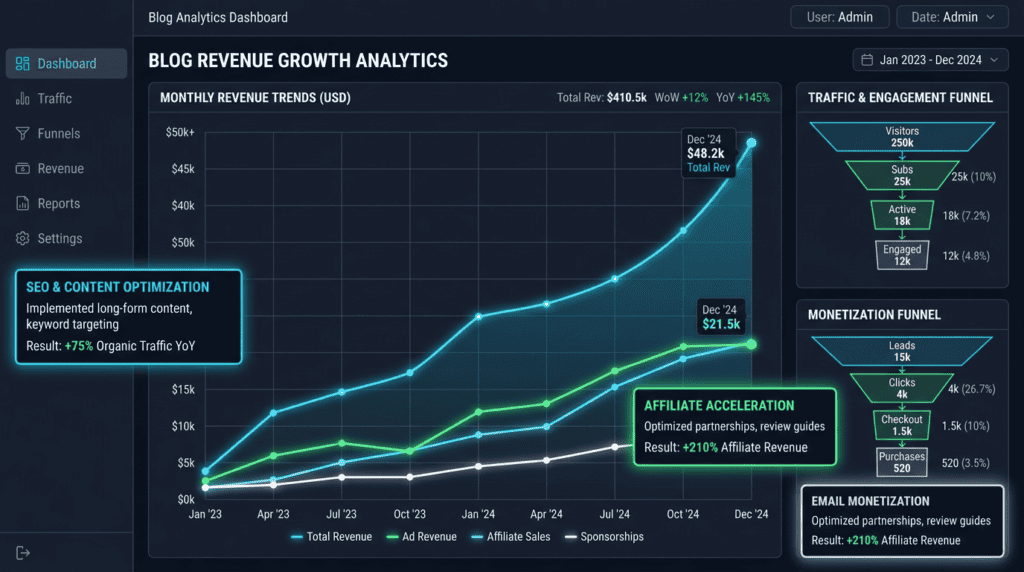
Email List Integration. Every serious affiliate blogger needs an email list. Period. When I update a product recommendation or find an exceptional deal, I email my list. These are warm, trusting readers who already know my voice. My email-driven affiliate clicks convert at nearly 3x the rate of organic search clicks. If you’re not building a list alongside your blog, you’re leaving serious money on the table.
FAQ: Affiliate Marketing for Bloggers
How much money can bloggers make with affiliate marketing?
Blog income from affiliate marketing varies widely. Beginners typically earn $100–$500 per month within their first year. Intermediate bloggers with consistent traffic can earn $1,000–$10,000 monthly. Top-tier affiliate bloggers regularly generate $20,000–$100,000+ per month through diversified affiliate programs and high-converting content strategies.
What are the best affiliate programs for new bloggers?
New bloggers should start with Amazon Associates for its low barrier to entry and universal product selection. Other beginner-friendly programs include ShareASale, CJ Affiliate, ClickBank, and Impact. Choose programs aligned with your niche that offer at least 30-day cookie durations and competitive commission rates.
How many blog posts do I need before adding affiliate links?
I recommend having at least 15–25 high-quality, informational posts published before aggressively adding affiliate content. This establishes topical authority with search engines and builds reader trust. However, you can strategically include affiliate links in relevant posts from day one as long as the content genuinely serves the reader first.
Do I need to disclose affiliate links on my blog?
Yes, absolutely. The FTC requires clear and conspicuous disclosure of affiliate relationships. Place a disclosure statement near the top of any post containing affiliate links. Failure to disclose can result in fines and loss of affiliate program membership. Transparency also builds reader trust and improves long-term conversions.
Is affiliate marketing still profitable for bloggers in 2025?
Yes. Affiliate marketing remains one of the most profitable monetization strategies for bloggers in 2025. The industry is projected to exceed $15 billion globally. While competition has increased, bloggers who focus on niche authority, search intent optimization, and genuine product recommendations continue to earn substantial passive income blogging.
My Top Recommended Gear
These are the tools and products I use daily to run my affiliate blogging operation. I’ve tested dozens of alternatives over the years — these are the ones that stuck:
- Ahrefs SEO Toolset — My go-to for keyword research, competitor analysis, and content gap identification. No serious affiliate blogger should operate without a proper SEO tool. Browse Ahrefs SEO Resources on Amazon →
- Logitech MX Master 3S Mouse — I spend 8+ hours a day writing and managing content. An ergonomic mouse isn’t optional; it’s a necessity. This one has been bulletproof for me. Check Price on Amazon →
- Content Strategy Planner & Notebook — I still map out my content clusters and editorial calendar on paper before touching a spreadsheet. Call me old-school, but spatial planning on a physical page hits different. Find Content Planners on Amazon →
Disclaimer: This post contains affiliate links. As an Amazon Associate and ClickBank Partner, I may earn a commission from qualifying purchases at no additional cost to you.