
Best AI Tools for Bloggers for Easy Growth

I’ve tested over a dozen AI tools as part of running Daily Net Blog — writing assistants, SEO tools, image generators, and research tools. Most didn’t last a week. Every tool on this list is one I’ve used for at least 30 days on real posts, not just a demo. I’ve noted exactly what each is actually good at.
Finding the best AI tools for bloggers shouldn’t require a PhD in prompt engineering or a second mortgage. Yet here you are—drowning in 47 browser tabs, each promising some magical AI tool that’ll turn your blog into a traffic machine overnight. The problem? Most of those tools are overhyped, half of them do the same thing, and nobody tells you which ones actually move the needle. I’ve spent over a decade building and scaling blogs, and in the last two years, I’ve tested more AI tools for blogging than I care to admit. This guide cuts through the noise. I’m sharing the exact stack I use, what I’ve ditched, and the tools that genuinely accelerate blog growth without turning your content into soulless robot paste.
Table of Contents
- What Are AI Tools for Bloggers?
- Best AI Writing Tools for Blog Content
- AI-Powered SEO Tools for Bloggers
- AI Image and Design Tools
- AI Content Strategy and Research Tools
- Myth-Busting: What AI Tools Can’t Do for Your Blog
- My Exact AI Blogging Stack (And What It Costs)
- Advanced Tactics: Using AI Tools Like a Pro
- Frequently Asked Questions
- My Top Recommended Gear
What Are AI Tools for Bloggers?
AI tools for bloggers are software applications that use artificial intelligence—primarily large language models, machine learning, and neural networks—to assist with writing, editing, SEO optimization, image creation, and content strategy. They don’t replace you; they amplify what you already do well and shore up your weaknesses. Think of them as a highly capable intern who never sleeps.
The category has exploded since ChatGPT launched in late 2022. According to McKinsey’s State of AI report, 72% of organizations now use AI in at least one business function—and content creation sits near the top of that list. For solo bloggers and small teams, AI tools for blogging represent the biggest productivity leap since WordPress itself.
But here’s what most “best AI tools” listicles won’t tell you: the tool matters far less than how you use it. I’ve watched bloggers spend $300/month on AI subscriptions and produce worse content than someone using the free tier of ChatGPT with a solid editing process. If you’re just getting started with blogging, understanding this distinction will save you real money and real headaches.
Best AI Writing Tools for Blog Content
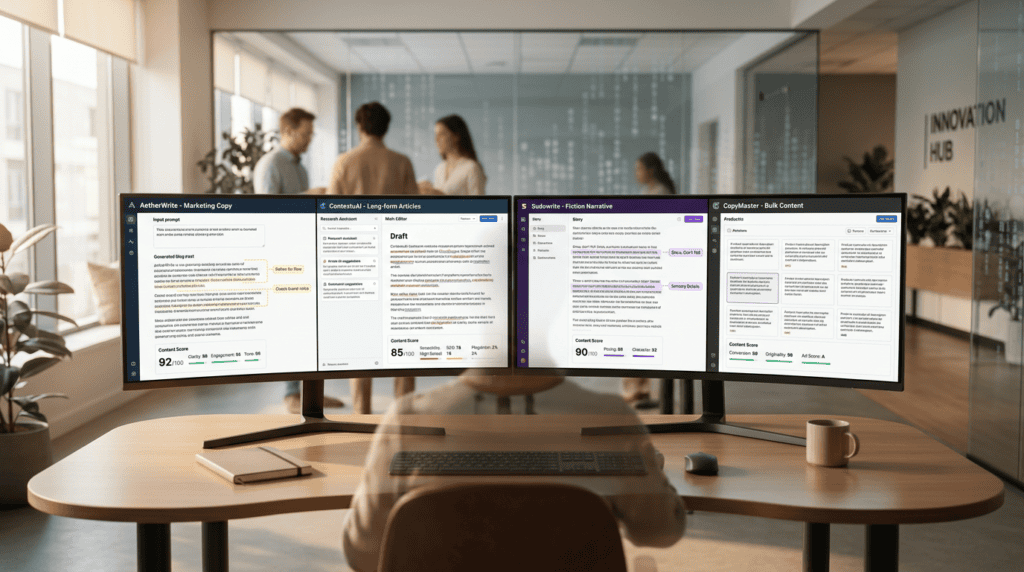
AI writing tools are the backbone of any blogger’s AI stack. Here are the ones I actually use and recommend after extensive testing:
ChatGPT (GPT-4o) — The Swiss Army Knife
I use ChatGPT daily. Not for writing entire posts (please don’t do that), but for brainstorming outlines, generating alternative headlines, rewriting clunky paragraphs, and researching unfamiliar subtopics. GPT-4o’s reasoning capability makes it genuinely useful for content strategy conversations. The $20/month Plus plan gives you enough for a full-time blogging operation.
Claude by Anthropic — The Better Writer
Hot take: Claude produces more natural-sounding long-form content than ChatGPT. I use Claude when I need a solid first draft that requires less de-robotifying. Its larger context window (200K tokens) means you can feed it your entire content brief, brand voice guidelines, and competitor analysis in one shot. For AI writing tools, this one’s underrated IMO.
Jasper AI — The Marketing-Focused Option
Jasper has repositioned itself as a marketing AI platform. It’s overkill for most solo bloggers, but if you’re running a content team or need built-in brand voice controls and campaign management, it earns its $49/month starting price. I recommend it primarily for bloggers who’ve already monetized and need to scale.
Grammarly — The Non-Negotiable
Every piece of content I publish passes through Grammarly. The free version catches embarrassing typos. The premium version ($12/month) offers tone adjustments and clarity suggestions. Pair it with any AI writing tool and your output quality jumps immediately. If you’re serious about building a blog that generates income, clean writing isn’t optional—it’s table stakes.
AI-Powered SEO Tools for Bloggers
Writing great content means nothing if nobody finds it. These SEO tools for bloggers use AI to give you a legitimate competitive edge in search rankings.
SurferSEO — My #1 On-Page Optimization Tool
SurferSEO analyzes the top-ranking pages for your target keyword and generates a content score based on word count, keyword density, headings, and NLP terms. I write every blog post with SurferSEO’s Content Editor open. It’s transformed my on-page SEO from guesswork into a data-driven process. Plans start at $89/month, and it’s worth every penny.
Semrush — The Enterprise-Grade Powerhouse
Semrush isn’t purely an AI tool, but its AI-powered features—keyword clustering, content gap analysis, and the SEO Writing Assistant—make it indispensable. Semrush’s own research shows that bloggers who optimize content with AI-driven recommendations see 30-50% more organic traffic within six months. I use it alongside SurferSEO, not instead of it.
NeuronWriter — The Budget-Friendly Alternative
If SurferSEO’s pricing makes you wince, NeuronWriter offers similar content optimization at a fraction of the cost. It pulls NLP recommendations, competitor analysis, and SERP data into one clean interface. At $19/month for the base plan, it’s the best entry point for bloggers learning SEO fundamentals.
AI Image and Design Tools

Stock photos are dead. Well, dying. AI image tools let you create custom visuals that actually match your content instead of using the same “person smiling at laptop” photo that 10,000 other bloggers grabbed from Unsplash.
Midjourney — The Quality King
Midjourney produces the most visually stunning AI-generated images, period. I use it for featured images, social media graphics, and custom illustrations. The $10/month Basic plan gives you ~200 images—more than enough for most bloggers.
Canva AI (Magic Studio) — The All-in-One Design Tool
Canva’s AI features—Magic Write, Magic Eraser, text-to-image generation—turn a tool most bloggers already use into an AI-powered content creation tool. The Pro plan ($13/month) bundles everything you need for blog graphics, Pinterest pins, and social media visuals.
DALL-E 3 (via ChatGPT) — The Convenience Play
If you already pay for ChatGPT Plus, you get DALL-E 3 image generation included. The quality sits below Midjourney but above most free alternatives. For quick hero images and in-post graphics, it eliminates the need for another subscription.
AI Content Strategy and Research Tools
This is where AI for content creators gets seriously powerful—and seriously underused.
Frase — Content Research on Steroids
Frase crawls the top 20 SERP results for any keyword and distills the key topics, questions, and statistics into a research brief in minutes. What used to take me 2-3 hours of manual research now takes 15 minutes. Starting at $15/month, it’s one of the highest-ROI blog growth tools I’ve found.
MarketMuse — The Content Gap Finder
MarketMuse uses AI to analyze your entire site and identify topical gaps, content decay, and internal linking opportunities. It’s pricey (plans start at $149/month), but for established bloggers managing 100+ posts, it pays for itself by showing you exactly which posts to update, which to write, and which to consolidate.
Speaking of content strategy—if you’re looking to monetize your blog through affiliate marketing, these research tools help you find buyer-intent keywords that most bloggers overlook entirely.
🔥 Pro Recommendation: AI Blogging Accelerator
If you’re serious about scaling your blog with AI, I recommend checking out the Blogging with AI Blueprint—a comprehensive training that teaches you how to build a profitable blog using AI tools the right way. It covers keyword research workflows, content optimization systems, and monetization strategies that actually work.
This is an affiliate link. I only recommend products I’ve personally vetted.
Myth-Busting: What AI Tools Can’t Do for Your Blog
Let me burst some bubbles here, because the hype around AI tools for blogging has created some dangerously wrong expectations:
- Myth: AI can write publish-ready blog posts. Reality: Every AI-generated draft needs heavy human editing. Google’s Search guidelines emphasize E-E-A-T (Experience, Expertise, Authoritativeness, Trustworthiness). AI has zero first-hand experience. You provide that.
- Myth: More AI tools = better results. Reality: I’ve seen bloggers juggle 8+ AI subscriptions and produce mediocre content. A focused stack of 3-4 tools beats a bloated toolkit every time.
- Myth: AI content automatically ranks. Reality: Google doesn’t care if a robot or a human wrote the content—it cares about quality, relevance, and helpfulness. Lazy AI content gets buried. Period.
- Myth: AI makes blogging “easy.” Reality: AI makes blogging faster. There’s a massive difference. You still need strategy, original insights, and consistent effort.
This video breaks down practical AI workflows for bloggers— the content optimization section, which mirrors exactly how I structure my own process.
My Exact AI Blogging Stack (And What It Costs)
Here’s what I actually pay for and use every week. No fluff, no tools I signed up for once and forgot about:
- ChatGPT Plus — $20/month (brainstorming, outlines, research, quick image generation)
- SurferSEO — $89/month (on-page optimization for every post)
- Grammarly Premium — $12/month (editing and proofreading)
- Canva Pro — $13/month (all visual content)
- Frase — $15/month (content research and briefs)
Total: $149/month. That’s my entire AI blogging tools stack. It replaced what used to require a freelance writer ($500+/month), a graphic designer ($300+/month), and an SEO consultant ($1,000+/month). The ROI speaks for itself 🙂
If you’re just starting out and need to keep costs minimal, grab ChatGPT free, Canva free, and Grammarly free. You can build a legitimate blog with zero AI subscriptions and upgrade as revenue grows. Check out my full recommended tools page for the complete breakdown including non-AI essentials.
Advanced Tactics: Using AI Tools Like a Pro
Want to know what separates bloggers who get marginal gains from AI versus those who 3x their output? It’s not the tools—it’s the workflow. Here are my top advanced tactics:
1. Build Custom GPTs for Your Brand Voice
ChatGPT lets you create custom GPTs with specific instructions. I built one trained on my writing style, target audience, and content guidelines. Every draft it produces sounds like me from the first sentence. Take 30 minutes to set this up and you’ll save hours of editing every week.
2. Use the “SERP-First” Research Method
Before writing anything, I feed the target keyword into Frase, analyze what’s ranking, then ask ChatGPT: “What are the top-ranking articles missing about [topic]?” This surfaces angles that competitors haven’t covered—which is exactly what Google rewards with higher rankings.
3. Layer Your SEO Optimization
I write the first draft with ChatGPT/Claude assistance, then optimize it in SurferSEO’s editor. But here’s the secret sauce: I run the optimized draft back through Claude and ask it to improve readability without losing the SEO terms. This double-pass approach consistently produces content that scores 80+ in SurferSEO while actually reading like a human wrote it. No cap, this single tactic has moved more needles than any other AI workflow I’ve tested.
4. Automate Your Content Calendar
I use ChatGPT to generate a quarterly content calendar based on my keyword research data. I export keyword clusters from Semrush, paste them in, and ask for a publishing schedule organized by topical relevance and seasonal trends. What used to take a full day of planning now takes an hour.
Frequently Asked Questions
What is the best AI tool for bloggers in 2025?
The best all-around AI tool for bloggers in 2025 is ChatGPT (GPT-4o) for drafting and brainstorming, paired with SurferSEO or NeuronWriter for on-page optimization. Most professional bloggers use a stack of 3-4 complementary tools rather than relying on a single solution.
Can AI tools replace human bloggers?
No. AI tools accelerate research, drafting, and optimization, but they cannot replace human experience, original perspectives, or genuine expertise. Google’s Helpful Content guidelines reward content that demonstrates first-hand experience (E-E-A-T), which AI alone cannot produce.
Are AI-generated blog posts penalized by Google?
Google does not penalize AI-generated content simply for being AI-generated. However, Google penalizes low-quality, unhelpful, or spammy content regardless of how it was produced. The key is to use AI as an assistant, then add your expertise, edit thoroughly, and ensure the content genuinely helps readers.
How much do AI blogging tools cost?
AI blogging tools range from free (ChatGPT free tier, Canva free plan) to $20-$200+ per month for premium plans. A solid starter stack of ChatGPT Plus ($20/mo), a free grammar tool, and a basic SEO tool runs about $50-$80 per month total.
What AI tools help with blog SEO?
The top AI-powered SEO tools for bloggers include SurferSEO, NeuronWriter, Clearscope, Semrush’s AI features, and Frase. These tools analyze top-ranking content, suggest optimal keyword usage, and provide real-time content scoring to help your posts rank higher in search results.
My Top Recommended Gear
Beyond software, the right hardware makes your blogging workflow smoother. Here are three products I use daily and recommend without hesitation:
- Logitech MX Keys Keyboard — The best typing experience for long-form writing. Backlit, quiet, and built like a tank. Check price on Amazon →
- Dell UltraSharp 27″ 4K Monitor — Screen real estate matters when you’re running SurferSEO, a Google Doc, and research tabs simultaneously. This monitor changed my workflow. Check price on Amazon →
- Sony WH-1000XM5 Headphones — Noise-canceling headphones are a non-negotiable productivity tool. I write twice as fast when the world disappears. Check price on Amazon →
Disclaimer: This post contains affiliate links. As an Amazon Associate and ClickBank Partner, I may earn a commission from qualifying purchases at no additional cost to you.