
The Pinterest Promotion System That Ends Decision Fatigue
Your Pinterest promotion strategy shouldn’t reset to zero every time you hit publish — but for most bloggers, that’s exactly what happens. The blog post is done. You’ve proofread it twice, added the images, hit publish. And instead of feeling finished, you open a new tab, land on Pinterest, and something in your chest goes quiet. Okay. Now what.
Disclosure: This post contains affiliate links. If you buy through them, DailyNetBlog may earn a small commission at no extra cost to you. See our full affiliate disclosure.
Not “now what” like you don’t know Pinterest exists. You’ve made pins before. You’ve read the guides. You know it can send traffic. It’s a smaller, more annoying “now what” — the one where you have to decide, again, from nothing, what this particular post needs.
Which image do I use? Does the pin need a different headline than the blog title, or the same one? How many pins — one, three, five? Which board does this even go on? Do I need new keywords, and where do those go? Should I schedule it or pin it now?
By the time you’ve answered all of that, you’re tired, and you still haven’t promoted anything. You’ve just been standing at the trailhead. That feeling has a cause. And it isn’t that you’re bad at Pinterest.
Table of Contents
Why Promoting Blog Posts on Pinterest Drains You
When you started blogging, everyone told you the hard part was the writing. Nobody mentioned that every finished post comes with a second, smaller job stapled to it — and that this job resets to zero each time.
So here’s what actually happens. You publish. You open Canva and stare at a blank pin. You try a design, don’t love it, try another. You rewrite the pin text four times because the blog title “feels flat as a pin.” You wonder if this is a one-pin post or a make-five-and-see-what-sticks post. You go looking for the board you’re pretty sure you made months ago. You second-guess whether these keywords are the right ones. Twenty minutes in, you’ve made two pins you feel lukewarm about, and you close the tab telling yourself you’ll batch the rest later.

You know that scene. You’ve lived it more than once. And the reason it feels so heavy isn’t the designing or the writing — it’s that you’re making every one of those decisions like it’s the first time you’ve ever promoted a post.
How Pinterest Decision Fatigue Disguises Itself as Strategy
Here’s the part that’s easy to miss about yourself. Somewhere along the way, you started believing that doing Pinterest well means giving each post its own custom treatment. A thoughtful, tailored approach. Fresh eyes every time. That sounds responsible. It sounds like the opposite of lazy. It’s also the exact thing wearing you down.
Here’s the thing: “a custom plan for every post” and “no plan at all” feel exactly the same when you’re doing them. Both mean you sit down to a blank screen and rebuild your whole Pinterest promotion strategy from scratch. You’ve been calling that hard work. It’s really just Pinterest decision fatigue in a nicer outfit. You think you’re being strategic. What you’re actually doing is refusing to let yourself repeat anything.
And the people whose Pinterest accounts quietly send traffic month after month? I’ve spent years watching blog Pinterest accounts, and the ones that quietly win aren’t more creative than you on a per-post basis. If anything, they’re more boring. They do nearly the same thing every single time they publish. Same handful of templates. Same headline pattern. Same number of pins. Same rule for which board. They’re not reinventing anything — they’re running a play they already decided on.
What Inconsistent Pinterest Promotion Costs Your Blog Traffic
The decisions feel small in the moment. That’s what makes them sneaky. But watch what a fresh round of them does to your behavior. Because promotion requires a mental cold-start every time, it slips. The post goes live and the pinning happens tomorrow, or three days later, or “when I have the energy.” Some posts get one rushed pin. Some get nothing at all, because you never found the momentum to begin. Your promotion ends up as inconsistent as your motivation on any given afternoon.
Pinterest has no idea you’re tired. It just sees an account that posts in random bursts — busy one week, silent the next. It can’t build momentum when it can’t predict what you’ll do.
So your blog traffic stays flat — and inconsistent promotion is one of the quiet traffic-killing mistakes that keep good posts invisible. Flat traffic feels like proof that Pinterest just doesn’t work for people like you. But that’s the wrong lesson from real evidence. Pinterest didn’t fail you. It never got a steady signal to work with, because you spent all your Pinterest energy deciding what to do instead of doing it. It’s worth remembering why steadiness matters so much here: pins outlive almost every other kind of social post — a single pin can keep surfacing in search and sending clicks for months, where a tweet fades in hours. Consistency is the whole engine.
There’s a quieter cost underneath all of it, too. When promoting a post feels like a puzzle, you slowly start to dread finishing posts. Publishing stops being satisfying. That’s a bad thing to let happen to the one activity your entire blog depends on.
Your Blog Post Is Unique — Your Pinterest Promotion Shouldn’t Be
By now a familiar thought has probably surfaced: I shouldn’t have to figure this out every single time. You’re right. You shouldn’t. And the reason you keep having to is worth seeing clearly, because it’s fixable.
Every blog post you write really is different. Different topic, different angle, different reader question. That part deserves fresh thinking — that part is the work. But somewhere, that truth leaked into the promotion, and you decided that because the post is unique, the way you promote it has to be reinvented too. It doesn’t. It actually shouldn’t.
Almost every decision you’re agonizing over on a per-post basis is a decision you could make once — at the category level, not the post level — and then never touch again. “Which board?” isn’t a question you answer per post. It’s a question you answer per topic, one time, and write down. “How many pins?” isn’t a judgment call. It’s a number you pick once and stop debating. The creativity belongs in the content. The distribution should be about as thoughtless as brushing your teeth. That’s the whole shift: stop making the same decisions twice.
How to Build a Repeatable Pinterest Promotion Checklist
What you want is a short, fixed sequence that kicks in automatically the second a post goes live — so that “publish” and “start promoting” become one motion instead of two, and none of it asks for fresh judgment. You build this Pinterest workflow by taking each recurring decision and killing it once, in advance:
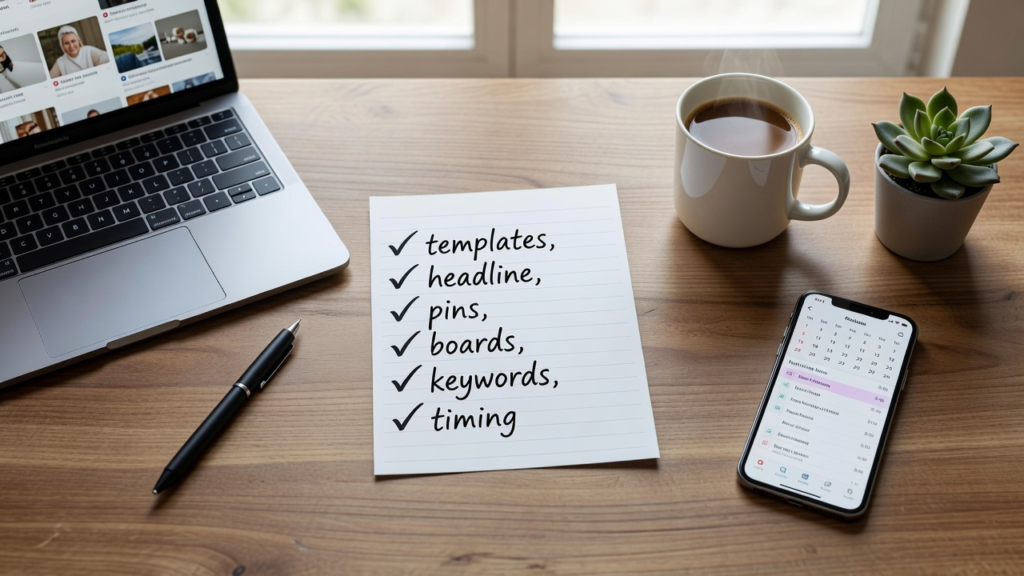
To promote blog posts on Pinterest consistently, make six decisions once and reuse them every time you publish:
- Pick one or two pin templates.
- Use a fixed pin-headline formula.
- Set a standard number of pins.
- Map each post category to a board.
- Pull keywords from the post itself.
- Schedule pins in a standing slot.
Pin Design: Use One or Two Pinterest Templates
Pick one or two templates and commit. The task stops being “design a pin” and becomes “drop this post’s title and image into template A.” The redesigning is the trap. The reuse is the point.
Pin Headline: Write From a Repeatable Formula
Decide on a formula instead of a fresh brainstorm — a repeatable shape you fill in, like a benefit plus a hint of curiosity. You’re never staring at a blank line again.
Number of Pins: Pick a Fixed Number Per Blog Post
Choose a fixed number for a standard post and make it a rule, not a mood. Now “how many?” is answered before you even sit down.
Boards: Map Post Categories to Pinterest Boards
Map your post categories to boards once. Recipe posts go here, budgeting posts go there. When a new post is done, you already know its home.
Keywords: Pull Pinterest Keywords From Your Post
Use one repeatable method — pull them from the post’s own title, its subheads, and the phrases you’d type to find it (the same keyword thinking behind solid blog SEO for beginners). Same extraction every time, no guessing.
Timing: Set a Standing Pinterest Schedule
Set a schedule and let it hold. A standing slot beats re-litigating “pin now or later?” on every single post.
Write these six answers down somewhere you’ll actually see them — a note, a checklist, an index card taped by your monitor. Then, the next time you publish, you don’t ask what am I supposed to do with this post now? You run the list. The thinking already happened. You’re just following it. That’s what you’ve been missing this whole time. Not a better pin. Not some secret Pinterest hack. A repeatable Pinterest system you can just follow — the same one, on purpose, every time. Fold it into your wider content creation workflow so publishing and promoting stop being two separate jobs.
Watch: A Simple Pinterest Promotion System in Action
Prefer to see it? This short walkthrough shows how a stripped-down, repeatable Pinterest strategy drives free blog traffic — the same “decide once, then just run it” idea in practice: A Super Simple Pinterest Strategy for Bloggers.
Tools to Run Your Pinterest Promotion System on Autopilot
Steady Pinterest traffic is also one of the cleanest foundations for affiliate marketing for bloggers — which is exactly why a few boring, cheap desk tools are worth having on hand to keep the system running:
- Ruled index cards — the literal home for your six-answer checklist. Write it once, tape it to your monitor, stop deciding.
- Undated content planner — lock in your standing pinning slot and batch a week of pins in one sitting instead of scrambling per post.
- Sticky note desk pad set — keep your pin-headline formula and board map in eyeline so the rules never leave your desk.
- A best-selling Pinterest marketing book — go deeper on keywords and pin SEO once your system is already running and you want to sharpen it.
The Payoff: Consistent Pinterest Promotion on Autopilot
You’ll know it’s working when publishing a post stops feeling like a question. You hit publish, you glance at your list, you make your pins the same way you made them last week, and you move on. No agonizing. No open tab that sits there until you close it in defeat. No fresh puzzle waiting on the other side of every article. Just a boring, repeatable motion that happens to be exactly the thing Pinterest rewards. That kind of dull consistency is exactly what Pinterest’s algorithm is built to reward — steady, predictable activity beats sporadic bursts every time.

So quit treating every post like a Pinterest puzzle you’ve never solved before. A Pinterest promotion strategy isn’t supposed to feel inspired — it’s supposed to run on autopilot, boring enough that you barely notice you’re doing it. That’s the version that lasts long enough for the traffic to actually show up. So do this now, before the sting of that blank Canva screen fades: write your six answers on one index card and tape it above your monitor. The next post you publish should be the last one you ever promote from scratch.
Frequently Asked Questions About Pinterest Promotion
How many pins should I make for each blog post?
Pick one fixed number and use it for every standard post — many bloggers land on three to five fresh pins. The exact number matters less than making it a rule instead of a per-post decision, so you never spend energy on “how many?” again.
Which Pinterest board should I pin a new blog post to?
Decide this once per topic, not per post. Map each blog category to a board — recipes to one, budgeting to another. When a post is done, its board is already chosen, and pinning takes seconds instead of a hunt.
How often should I pin to Pinterest?
Consistency beats volume. Set a standing schedule you can actually keep, even just a few pins a day in a fixed slot, and let it run. Pinterest rewards steady, predictable activity far more than it rewards big unpredictable bursts.
Do I need a brand-new pin design for every blog post?
No. Reusing one or two templates is the whole point, not a shortcut. Drop each post’s title and image into your template and move on. The redesigning is what burns you out; the reuse is what makes promotion sustainable.
Why is my Pinterest traffic flat even though I post good content?
Usually it’s inconsistency, not quality. When promotion depends on fresh motivation each time, it slips — and Pinterest can’t build momentum on a signal it can’t predict. A fixed, repeatable system steadies the input, and the traffic tends to follow.
What’s the fastest way to promote a blog post on Pinterest?
Turn six recurring decisions — templates, headline formula, number of pins, boards, keywords, and timing — into a written checklist you make once. After that, every publish becomes “run the list” instead of “start over from scratch.”