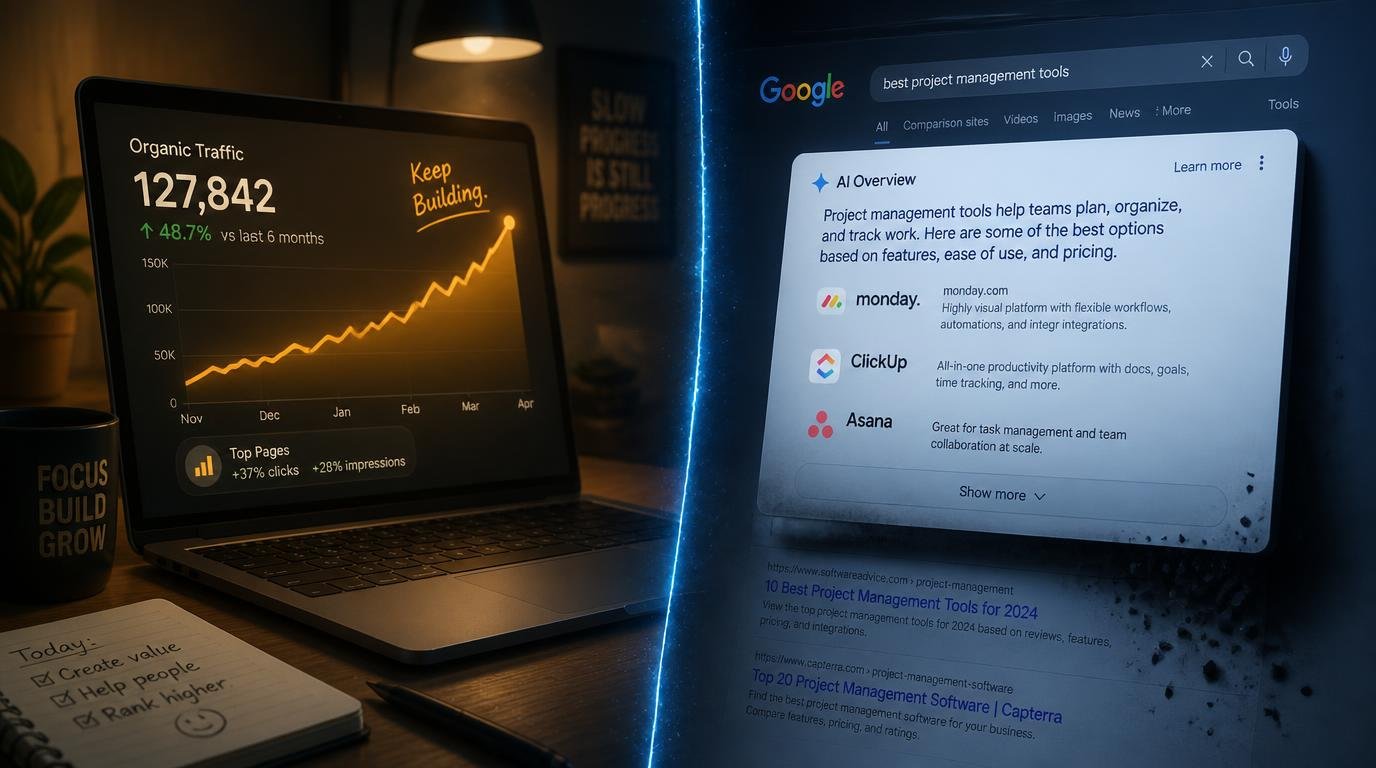
How to Get Blog Traffic When Google AI Overviews Steal Your Clicks
Your blog traffic is bleeding out, and Google’s AI Overviews are holding the knife. Here’s the stat that should make you sit up: when an AI summary shows up in the results, people click a normal blue link only 8% of the time, compared to 15% when there’s no summary at all — and they click the little source links inside the AI box a pitiful 1% of the time, according to a Pew Research Center study of nearly 69,000 searches. So you did everything right. You ranked. You still lost the click. That stings, and pretending otherwise helps nobody.
But I want to reframe what you’re feeling right now. You don’t have a ranking problem. You have a destination problem — Google turned itself into the answer instead of the doorway. And once you understand that shift, you can stop chasing a game that changed and start playing the one that actually pays out in 2026. That’s what the rest of this piece is about: diagnosing exactly where your clicks went, and the specific moves that win them back. Let’s go. 🙂
Table of Contents
- Where Your Blog Traffic Actually Went
- Why Ranking #1 Quietly Stopped Being Enough
- The Traffic That’s Still Yours to Win
- How to Get Your Blog Cited Inside AI Overviews
- Building Traffic Google Can’t Touch
- The Metrics That Actually Matter Now
- Frequently Asked Questions
- My Top Recommended Gear
Where Your Blog Traffic Actually Went
Google AI Overviews reduce blog traffic by answering the searcher’s question directly on the results page, so fewer people click through to your site. Pew Research found clicks to standard results drop from 15% to 8% when an AI summary appears, and agency studies report organic click-through rates falling more than 50% on affected informational queries.
Ever refresh Search Console, see your rankings holding steady, and watch your traffic graph slide off a cliff anyway? You’re not imagining it, and you’re definitely not alone. The mechanism is simple and brutal: Google now writes the answer at the top of the page, so the searcher gets what they came for without ever leaving Google’s front yard.
The numbers back up the gut feeling. Performance agency Seer Interactive tracked more than 3,000 informational queries and found organic click-through rates fell roughly 61% on searches that trigger an AI Overview, as reported by Search Engine Land. Ahrefs, analyzing hundreds of thousands of keywords, first clocked a 34.5% CTR drop for the #1 position and later measured that decline widening to around 58% for top-ranking pages as coverage expanded, per additional Search Engine Land coverage. Different methods, same direction of travel: down.
And here’s the part nobody warns you about. Even queries without an AI Overview are seeing softer click rates, because searchers are getting trained across the whole web — Google, ChatGPT, Perplexity — to expect the answer served to them. TBH, this isn’t a temporary dip you wait out. It’s a behavior change, and behavior changes don’t reverse. If your growth plan still relies on tools like building traffic without chasing backlinks, that instinct is right — you just need to point it at the new reality.
Why Ranking #1 Quietly Stopped Being Enough
Want to know the most expensive belief in blogging right now? “If I can just rank first, I’ll get the traffic.” That was gospel for two decades. It’s now a myth that’s actively costing people their income.
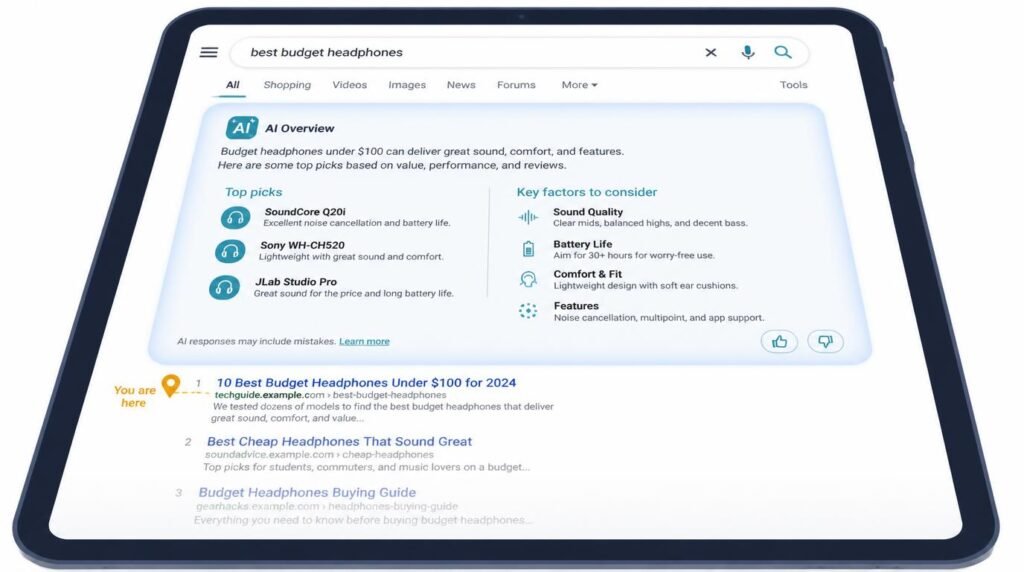
Position one still matters — but its value collapsed the moment an AI Overview started sitting above it. Think about the real estate on a modern results page: the AI summary loads first, expands to fill the screen, and your hard-won #1 organic listing gets pushed below the fold where a shrinking fraction of people ever scroll. You didn’t lose the ranking. You lost the visibility the ranking used to guarantee. Those are two completely different things now, and conflating them is why so many bloggers feel gaslit by their own analytics.
Let me bust a second myth while I’m at it: the idea that getting cited inside the AI Overview is a consolation prize. It’s the opposite. The Seer data showed that brands cited within an AI Overview earned about 35% more organic clicks than those left out of it entirely. Citation is becoming the new position zero — the slot that used to be the featured snippet is now a mention inside the AI answer itself. Most of your competitors have zero strategy for earning it. That gap is your opening, which I’ll show you how to exploit in a moment.
The Traffic That’s Still Yours to Win
So is the open web just cooked? Not even close — and this is where the diagnosis turns tactical. AI Overviews don’t fire evenly. They swarm certain queries and largely ignore others, and knowing the difference tells you exactly where to aim.
Pew’s data revealed a pattern worth tattooing on your monitor: short, one-or-two-word searches rarely triggered an AI summary, while queries with ten words or more triggered one over half the time. In other words, the “what is X” and quick-definition traffic is the most vulnerable, because a machine can resolve it in a sentence. The queries that survive are the ones a summary can’t satisfy — searches where the reader needs your judgment, your process, your screenshots, your opinion, or your first-hand result.
That reframes your whole content strategy. Stop competing to be the fastest definition and start being the destination for things that resist summarization: original data you gathered yourself, honest product comparisons with real trade-offs, step-by-step walkthroughs with your own screenshots, and strong points of view a bland AI answer will never risk taking. This is also where smart keyword work earns its keep — targeting the low-competition, high-intent keywords worth mapping that AI can’t cleanly answer keeps you in front of readers who still need to click.
How to Get Your Blog Cited Inside AI Overviews
Okay, so how do you actually earn a spot inside the AI answer that’s currently eating your lunch? This is the advanced section — the stuff most surface-level posts won’t tell you because they haven’t tested it. Here’s what consistently moves the needle, in the order I’d tackle it.
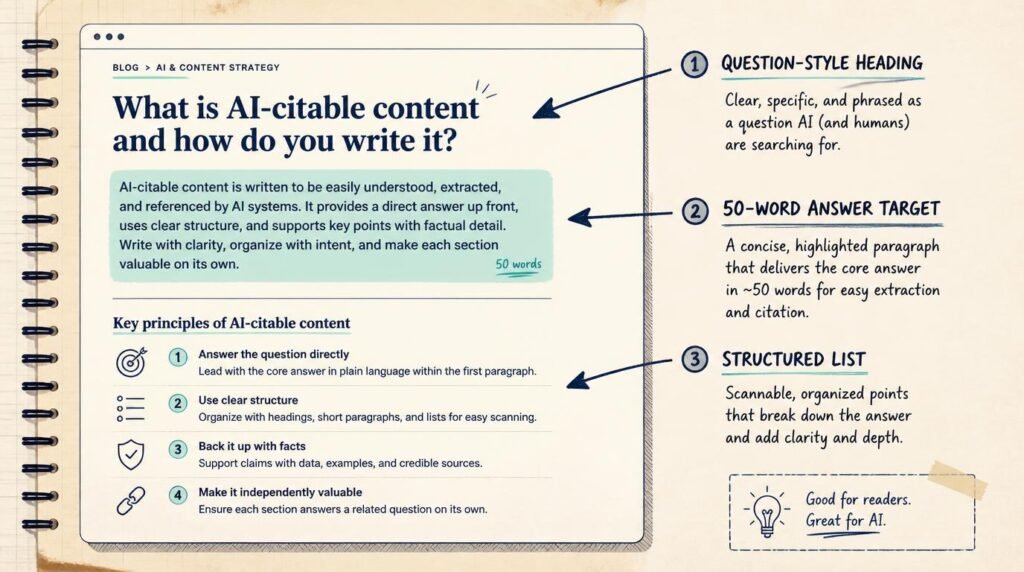
- Front-load a clean, quotable answer. AI engines lift the passage that resolves the query fastest. Open the relevant section with a direct 40-to-70-word answer, in plain declarative sentences, before you elaborate. If a machine can extract one tidy paragraph and cite it, you win the mention.
- Write headings the way people actually ask. Every subheading should read like a real spoken or typed question — “how do I get my blog cited in AI Overviews” beats “AI Citation Optimization.” Conversational, long-tail phrasing matches how AI systems parse intent.
- Show real experience, not recycled summary. AI models and Google’s quality systems both reward first-hand signals: your own numbers, your own tests, your own mistakes. Recycled generic advice is exactly what the AI already generated for free — give it something only you have.
- Build genuine topical depth. One thin post rarely gets cited. A strong core page supported by linked deep-dives signals that you own the topic, which correlates with higher citation rates. Cover the subject completely across a cluster, not in one isolated article.
- Earn third-party mentions. AI engines lean heavily on sources they already trust, and they cite earned, off-site references more than self-promotional pages. Guest posts, digital PR, being quoted in industry roundups — consistent mentions across credible sites raise the confidence a model has in naming you.
None of this is a hack, and ngl, that’s the point. There’s no keyword-stuffing shortcut left. The engines got smart enough that “be the genuinely most useful, most clearly structured, most trustworthy source” is now also the winning optimization play. Funny how that worked out.
Building Traffic Google Can’t Touch
Here’s the counterintuitive claim I promised earlier: the best defense against Google AI traffic loss isn’t better SEO. It’s owning channels Google doesn’t control at all. Let me explain why that’s not the cop-out it sounds like.
Every visitor who reaches your blog through search is a rental. Google sets the terms, and Google can change them overnight — which is precisely what just happened to you. The antidote is to convert that rented attention into something you own outright before it evaporates. That means capturing emails, building a genuine community, and showing up on platforms where an AI summary can’t intercept the relationship. When someone’s on your newsletter list, no algorithm stands between you and them.
There’s an upside hiding in the AI shift, too. Adobe’s analysis found that referral traffic from generative AI tools grew more than tenfold in a matter of months, and those visitors browsed more pages and bounced far less than typical search traffic — they arrive pre-informed and higher in intent. So while raw click volume is falling, the clicks you do earn (and the AI referrals you pick up) can be worth more per visit. Fewer people, warmer people. That’s a trade a smart blogger can absolutely work with.
The Metrics That Actually Matter Now
If you take one thing from this, make it this: stop grading yourself on a metric the game abandoned. Raw sessions from organic search is a 2019 scoreboard. Keep watching it and you’ll feel like you’re losing even when you’re winning the new game.
What I track now, and what I’d urge you to start watching: share of voice across AI answers (how often your brand gets named when someone asks an AI about your topic), citation frequency inside AI Overviews and tools like ChatGPT and Perplexity, email list growth as your owned-audience insurance policy, and revenue or conversions per visit rather than visits alone. A single AI citation that pre-sells a reader can outperform a dozen cold clicks that bounce. Google’s own Search Console folds AI Overview impressions into your reports without cleanly separating them, so pair it with a dedicated AI-visibility tracker to see the full picture.
The bloggers who’ll thrive through this aren’t the ones clinging to the old click. They’re the ones who noticed the ground shift, stopped mourning the traffic model that died, and rebuilt around visibility, trust, and audiences they own. You’re clearly one of them — you read this far. Now go rewrite one post as an answer-target and watch what happens.
Frequently Asked Questions
Are Google AI Overviews really reducing blog traffic?
Yes, and the research is consistent. Pew Research found people click a traditional result only 8% of the time when an AI summary appears, versus 15% without one, and click the source links inside the summary just 1% of the time. Agency studies from Seer and Ahrefs report organic click-through rates falling by more than half on affected informational queries. The decline is real, measurable, and unlikely to reverse.
How do I get my blog cited inside an AI Overview?
Answer the exact question early and directly in about 40 to 70 words, use clear question-style headings and FAQ blocks, prove first-hand experience with your own data and examples, and earn mentions on third-party sites AI engines already trust. Citation depends far more on clarity, structure, and genuine topical depth than on keyword volume or backlink count alone.
Which blog topics are hit hardest by AI Overviews?
Simple informational and how-to queries suffer most, because a machine can resolve a definition or quick answer without a click. Longer, natural-language questions trigger AI Overviews far more often — over half the time for ten-word-plus queries. Transactional, local, opinion-driven, and experience-based searches are less affected so far, which is where you should concentrate new content.
Should I stop doing traditional SEO because of AI search?
No. Traditional SEO still feeds AI systems the very content they summarize and cite, so strong rankings remain a prerequisite for citation. The upgrade is to keep ranking while also optimizing for citation and diversifying into channels you own, like email, so no single algorithm change can wipe out your traffic overnight.
Does traffic from AI search convert better than regular organic traffic?
Often, yes. Early data shows visitors arriving through AI tools browse more pages and bounce less, likely because they arrive already informed and higher in intent. The volume is lower than classic organic search, but the quality per visit tends to be higher — which is exactly why visibility and citation now matter as much as raw clicks.
My Top Recommended Gear
These are the categories of tools I’d point any blogger toward for adapting to AI search. Vet each one against your own workflow before you commit — pick the specific product that fits how you actually work.
- An all-in-one SEO and AI-visibility platform — because tracking rankings alone no longer tells you the whole story; you want one that also monitors AI citations. See options
- A modern SEO / content strategy book covering AI search — a solid recent title will ground the tactics here in a fuller framework you can revisit. Browse titles
- An email marketing service for owned-audience building — the single best insurance policy against algorithm-driven traffic loss is a list you control. Compare picks
Disclaimer: This post contains affiliate links. As an Amazon Associate, I may earn a commission from qualifying purchases at no additional cost to you. I only recommend products and categories I’ve researched and believe are genuinely useful — please verify that any specific product fits your needs before buying.