

Repurpose One Blog Post Into A Week of Content

You want to repurpose one blog post into a week of content — but every time you try, it feels like handing your audience leftovers. So you stop. You write the thing. You research it. You edit it three times. You hit publish, it gets a few claps, and it sinks like a stone. Then tomorrow needs content too. And the day after that. Here’s the truth nobody tells you: the problem isn’t that you don’t write enough. It’s that you throw away almost everything you write. Repurposing fixes that — and no, it does not turn you into a spam machine.
Let me guess what you’re thinking.
Table of Contents
Repurposing vs. Reposting: Why Your First Try Flopped
I know exactly who you are. You’ve heard “repurpose your content” from every marketing guru with a ring light. You tried it once. You chopped your blog post into five tweets. You pasted the intro into LinkedIn. It flopped. Worse, it felt cheap. Like you were feeding your audience leftovers.
So you decided repurposing is for lazy people. Real creators make fresh work every day. Right?
Wrong. And I can prove it.
What you did wasn’t repurposing. It was reposting. Those are two completely different things.
Reposting is copy-paste. Repurposing is translation.
Think about a great book turned into a movie. Same story. Totally different craft. Nobody watches the film and says “ugh, leftovers.” They experience the same idea in a form built for a new room.
That’s the whole game. And once you see it, you can’t unsee it.
How Bad Is Organic Reach? Almost Nobody Saw Your Post
Here’s the fact that should sting a little. Organic reach on most platforms is brutal. A typical Instagram post reaches only a small slice of your own followers. On Facebook, business page reach often sits in the low single digits — industry benchmarks have pegged it around 1–2% for years. Your email open rate? Maybe a third of your list, on a good day.
Read that again. Even your best fans miss most of what you make.
So when you say “I already posted about this,” you’re wrong — and it’s costing you money. You posted it once. Only a sliver of your audience saw it. The other 90% never did. They’re not sick of your idea. They’ve never met it.
This kills the biggest objection right here. You’re not repeating yourself to the same people. You’re reaching new slices of your audience each time.
The people who did see it need repetition to remember it anyway. Marketing even has a name for this: the Rule of 7 — the long-standing principle that people need to encounter a message about seven times before it sticks. One post is a whisper in a hurricane. Seven posts is a message.
Social reach fades in hours. Search doesn’t — a post tuned with solid blog SEO for beginners can keep pulling readers for months, which is exactly why repurposing across search and social beats leaning on either one alone.
Why Repeating Your Message Builds Authority
You think repeating an idea is amateur hour. The opposite is true.
Comedians run the same joke across a hundred shows until it’s perfect. Musicians play their hit song at every single concert. Politicians hammer the same three lines for a year.
Are they lazy? No. They understand something you’re resisting. One idea, delivered many ways, is how influence actually works.
Steve Jobs gave a version of the same speech for years. The best keynote speakers reuse their strongest stories on every stage. They don’t invent a new philosophy each morning. They take one strong belief and they say it, and say it, and say it.
Novelty is not the goal. Memorability is. And you cannot make something memorable if you only say it once and run away.
The Hidden Cost of Publishing Fresh Content Every Day
Let’s talk about what your current approach is doing to you.
You write a post. You publish it. You abandon it. You start over. Every day is a blank page and a small panic.
This is not sustainable. It’s a treadmill set to sprint.
And here’s the cruel part: the “fresh every day” grind produces worse work, not better. When you have to invent something new daily, you rush. Rushed ideas are shallow ideas. You never go deep because you never revisit anything.
Content repurposing flips this. You write one thing well. Really well. Then you spend the week pulling more from it instead of replacing it — the backbone of any sustainable content creation workflow. Your best idea gets seven shots at landing instead of one.
I won’t pretend this is effortless — translating an idea well still takes judgment. But it takes a fraction of the energy of facing a blank page every morning.
Depth beats novelty. A creator who explores one strong idea from seven angles looks like an expert. A creator who fires off seven random takes looks scattered. Guess which one people trust with their money.
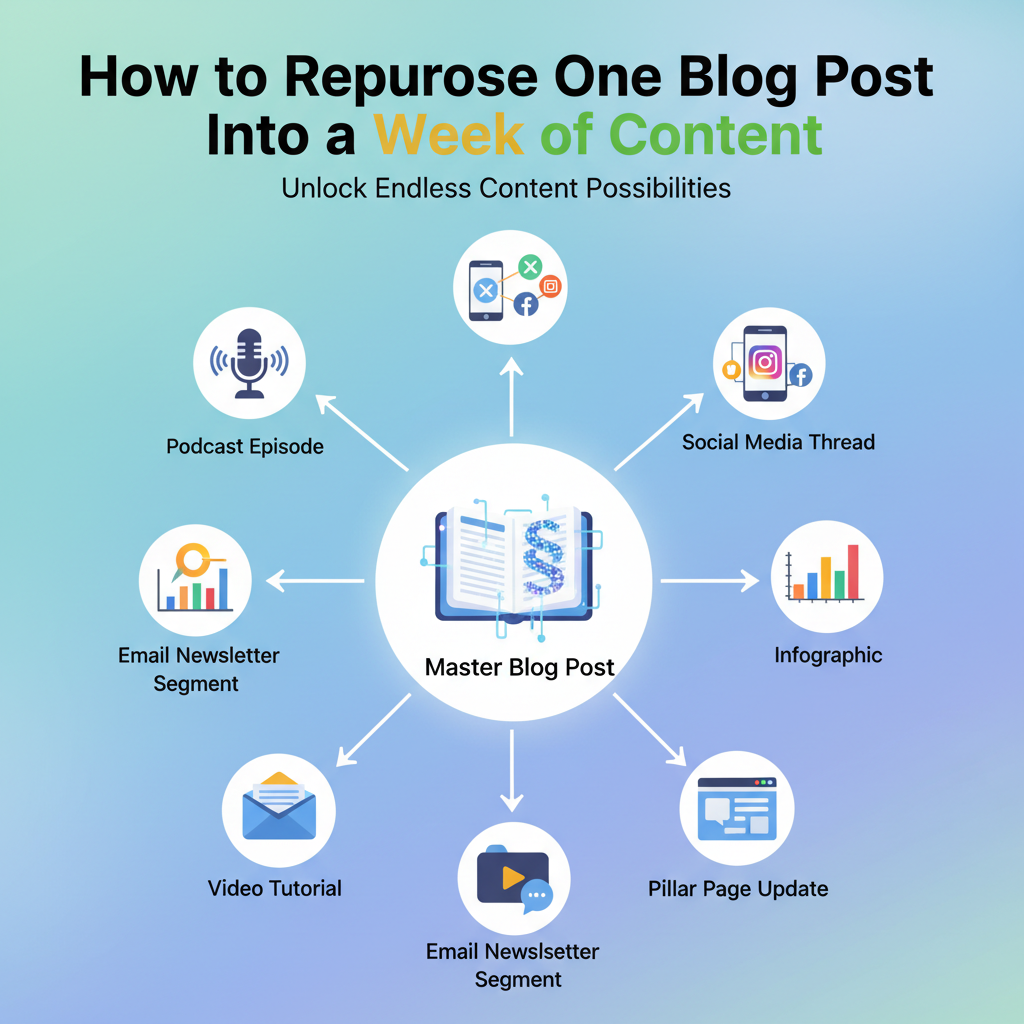
How to Turn One Blog Post Into 7 Pieces of Content
You think a blog post is one piece of content. It’s not. It’s a warehouse. And the more clearly the original is built — a real blog post structure, not a ramble — the more you can pull out of it.
How do you repurpose one blog post into a week of content? Break a single post into seven native pieces:
- Turn the core argument into a bold hook post.
- Make each main point its own short post.
- Turn a surprising stat into a scroll-stopping graphic.
- Script a story or example into a 30-second video.
- Build a step-by-step section into a carousel or checklist.
- Turn a strong quote into a shareable text image.
- Spin the reader questions it raises into a Q&A or poll.
That’s seven distinct pieces. From one post. And I was being conservative.
Each one is native to its platform. The tweet reads like a tweet. The video feels like a video. Nobody gets leftovers. Everybody gets a meal cooked for their table.
This is the difference between chopping and translating. Chopping shrinks your idea. Translating dresses it for a new audience.
Will My Audience Notice I’m Repurposing Content?
This is the fear under all the other fears. You think your followers are watching your every move, ready to catch you recycling.
They’re not. I say this with love.
People do not follow you across every platform. Your LinkedIn crowd and your Instagram crowd barely overlap. The person who reads your newsletter probably doesn’t watch your Shorts.
Each platform is a separate room full of different people. Saying the same smart thing in each room is not repetition. It’s just doing your job.
And even the rare superfan who follows you everywhere? They won’t feel spammed if you translate well. They’ll feel reinforced. They’ll think, “This person really knows their stuff.” Consistency reads as the authority Google actually rewards, not laziness.
The creators who look everywhere at once, always on message, always sharp? They’re not writing more than you. They’re repurposing content smarter than you.
The Content Repurposing Math: 2 Posts, 14 Pieces
Let me make this concrete, because feelings lie and numbers don’t.
Say you write two blog posts a month. That’s your ceiling for deep work. Fair.
Under the “fresh daily” model, you post those two pieces plus a handful of tired one-liners you scraped together at 11 p.m. Your output is thin. Your reach is tiny. You’re exhausted.
Now run the content repurposing model on those same two posts.
2 posts × 7 pieces each = 14 pieces of content.
Spread across the month, that’s a piece every other day. Across three platforms, that’s real presence in three rooms.
Same writing effort. Same two deep ideas. Roughly seven times the output. Seven times the reach. And you’re not burned out, because the hard thinking was done once.
You didn’t work more. You stopped wasting what you made. That’s not a hack. That’s basic respect for your own labor.
Is Repurposing Content Cheating? No — Here’s Why
I’ll meet you here one last time, because this is the emotional core. You care about your craft. Repurposing feels like cutting corners. Like the “real” creators would never.
Flip it around.
Right now you spend hours making something excellent, then let 90% of your audience miss it forever. Then you burn yourself out making the next thing they’ll also miss.
That’s not craftsmanship. That’s self-sabotage with extra steps.
Real respect for your work means fighting for it to be seen. It means giving your best idea every chance to reach the people who need it. Abandoning a great post after one weak launch isn’t noble. It’s a waste.
The most disciplined creators aren’t the ones grinding out new stuff daily. They’re the ones who take one strong thing and refuse to let it die quietly.
That’s not cheating. That’s the whole job.
Common Repurposing Objections, Answered
Let’s put the resistance to bed, point by point.
- “It’s lazy.” No. Translating one idea into seven native formats takes skill and intent. Copy-paste is lazy. This isn’t that.
- “My audience will notice.” They won’t. Different platforms, different people, tiny overlap. And repetition builds memory anyway.
- “It cheapens my brand.” The opposite. Showing up consistently with one clear message is how brands earn trust.
- “Fresh content is better.” Depth beats novelty every time. One idea explored fully makes you an expert. Seven scattered takes make you noise.
- “I’ve tried it and it flopped.” You reposted. You didn’t repurpose. Now you know the difference.
Every wall you’ve built against this has a door. I just walked you through each one.
How to Start Your First Content Repurposing Sprint
You’re already doing the hard part. You write good posts. Then you let most of their value evaporate the second you hit publish. That’s the real problem — not your output, your waste.
So fix it before you close this tab. Open your best-performing blog post from the last few months and pull out seven things: the core argument, three main points, one stat, one story, and one quote. There’s your week, already written.
Don’t write something new tomorrow. Repurpose that one blog post into a week of content instead. Your best ideas deserve more than a single shot — and so do you.