

Batch Write Blog Content Like a Pro: Proven Hacks

Batch Write Blog Content sounds like a productivity trick, but it can completely change how a solo blogger operates. Instead of spending an entire afternoon researching one post, writing it, editing it, and then staring at a blank page again, you build a repeatable production line.
That matters because inconsistent publishing rarely comes from a lack of ideas. It usually comes from context switching. You research one topic, answer an email, check analytics, search for an image, return to the draft, forget your original thought, and suddenly three hours have disappeared.
I know that cycle well. The fix isn’t necessarily writing faster. It’s removing unnecessary decisions from the writing process. When you group similar tasks together, you protect your attention, create momentum, and make a publishing schedule far easier to maintain.
For a site publishing roughly 1.5 posts per week, you don’t need a massive content factory. You need a small, predictable system that keeps two or three articles moving through different stages at the same time. TBH, that’s where the real productivity win happens.
Table of Contents
- What Is Batch Writing and Why Does It Work?
- How Do You Build a Practical Batch Writing Workflow?
- Why Should You Research Multiple Articles Together?
- How Can Outlines Make Blog Writing Faster?
- How Do You Run a High-Output Writing Sprint?
- How Does Batch Writing Improve Your SEO Content Strategy?
- What Batch Writing Mistakes Should You Avoid?
- What Does a Simple Seven-Day Batch System Look Like?
- Frequently Asked Questions
- My Top Recommended Gear
What Is Batch Writing and Why Does It Work?
Answer Target: Batch writing blog content means grouping similar content tasks into focused sessions. Instead of completing one article from start to finish, you research several topics, outline them together, draft in a dedicated writing block, and edit later. This reduces context switching and creates a more predictable publishing workflow.
Why does this simple change make such a noticeable difference?
Because your brain pays a hidden cost every time you switch tasks. Research requires curiosity. Outlining requires structure. Drafting requires sustained attention. Editing requires critical judgment. Asking your brain to jump between all four every twenty minutes creates friction.
Batching removes much of that friction.
Imagine you have four article ideas. Instead of researching Idea A, drafting it, editing it, finding an image, publishing it, and then starting over, you research all four first. Then you outline all four. Then you write two. You edit two. Suddenly, you’re not repeatedly rebuilding your mental context.
The goal isn’t to produce mediocre articles at industrial scale. It’s to make quality production easier to repeat.
That distinction matters. Google’s own guidance emphasizes creating helpful, reliable content for people rather than producing content simply to manipulate search rankings. Your batch workflow should therefore improve your editorial discipline, not turn your blog into a content conveyor belt. Google’s guidance on creating helpful content is a useful reference when designing your process.
How Do You Build a Practical Batch Writing Workflow?
What would happen if you stopped treating every article as an isolated project?
You’d start seeing your blog as a pipeline.
For a publishing schedule of around 1.5 posts per week, I recommend keeping six to eight potential topics in your idea bank while actively moving two to four articles through production. You don’t need every article finished before the next one begins.
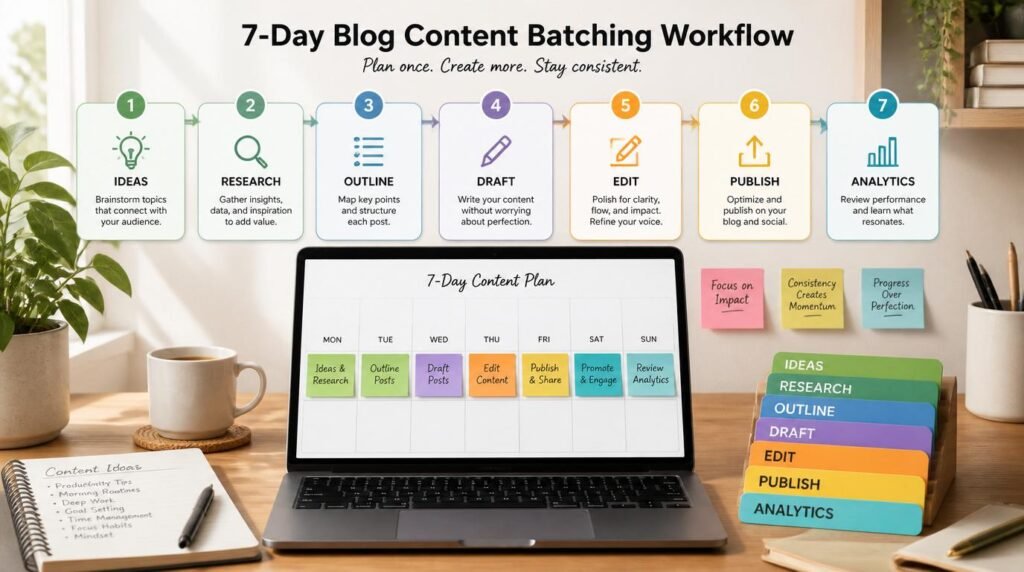
Here’s the basic workflow:
- Stage 1: Ideas — Collect questions, keywords, customer problems, trends, and content gaps.
- Stage 2: Validation — Confirm search intent, audience relevance, competition, and monetization potential.
- Stage 3: Research — Gather facts, expert sources, examples, statistics, and product information.
- Stage 4: Outlining — Build the article structure, internal links, FAQs, and conversion points.
- Stage 5: Drafting — Write without constantly stopping to research.
- Stage 6: Editing — Improve clarity, accuracy, originality, and reader experience.
- Stage 7: Publishing — Add images, metadata, links, schema, and final SEO checks.
The key insight is that these stages don’t have to happen on the same day.
For example, Monday might become your research day. Tuesday could focus on outlining. Wednesday and Thursday could handle drafting. Friday could handle editing and publishing. That structure creates a rhythm without forcing you to write seven days a week.
If generating ideas constantly feels like the hardest part, build your topic inventory from real questions instead of staring at a blank document. My workflow for coming up with content ideas consistently can help you create a stronger pipeline before you start batching.
Why Should You Research Multiple Articles Together?
Have you ever started writing an article only to discover that every other paragraph requires another Google search?
That’s one of the biggest productivity leaks in blogging.
Research interruptions destroy writing momentum. You start drafting a section about a topic, realize you need a statistic, search for it, open five tabs, discover a related study, then suddenly you’re reading something completely unrelated.
I prefer a research-first system.
Take three related articles and research them together. Build a simple research sheet with these columns:
- Primary keyword
- Search intent
- Reader problem
- Key entities
- Supporting keywords
- Statistics
- Expert sources
- Product opportunities
- Internal links
- Questions readers still have
Now you’re not researching articles. You’re researching a topic cluster.
That shift can reveal connections that you might miss when working article by article. One article may target an informational query, another a comparison query, and another a transactional query. Together, they can support a much stronger content architecture.
For content marketing research, I also recommend using audience questions as raw material. Customer questions often reveal language that keyword tools miss because they reflect how real people describe their problems. You can find more ideas in this guide to turning customer questions into content ideas.
When researching statistics, studies, and technical claims, verify the original source whenever possible. Google Scholar can help locate academic research, while government and university websites often provide authoritative primary information.

How Can Outlines Make Blog Writing Faster?
What if the fastest way to write an article isn’t to start writing?
It sounds backward, but a strong outline can eliminate dozens of micro-decisions during drafting.
Before I write, I want to know the job of every section. I don’t necessarily write every sentence in advance. Instead, I create a logical route for the reader.
A useful outline might look like this:
- Hook: What problem makes the reader care?
- Promise: What will the article help them accomplish?
- Core answer: What is the clearest direct response?
- Process: What steps should they follow?
- Proof: What evidence supports the recommendation?
- Insider insight: What would an experienced practitioner do differently?
- Objection: What might the reader disagree with?
- Action: What should they do next?
For SEO, I also map internal links during outlining. That prevents the awkward end-of-article scramble where you suddenly realize the new post should connect to three older resources.
My rule is simple: every article should have a clear purpose in the site’s broader content system. If two posts target the same search intent, I either combine them, differentiate them sharply, or rethink one of them.
That approach also makes AI-assisted writing more useful. AI can help expand an outline or suggest missing subtopics, but your strategic decisions should happen before the drafting stage. Otherwise, you risk producing a polished article that has no clear reason to exist.
How Do You Run a High-Output Writing Sprint?
Ready for the part most bloggers overcomplicate?
The writing sprint.
Once research and outlines are complete, drafting becomes dramatically easier because you aren’t asking yourself what to write next every five minutes.
Try a 90-minute sprint:
- Minutes 0–10: Review the outline and define the article’s main promise.
- Minutes 10–55: Draft continuously without polishing every sentence.
- Minutes 55–65: Take a real break away from the screen.
- Minutes 65–85: Complete unfinished sections and strengthen transitions.
- Minutes 85–90: Record missing research items for the editing session.
Notice what I didn’t include: constant grammar correction.
Editing while drafting feels productive, but it often creates a false sense of progress. You’re improving sentences that may later disappear entirely.
Write the rough version first. Then edit with fresh eyes.
At my preferred cadence, I would rather have two strong drafts at 80% completion than one article polished to perfection while the rest of the content pipeline sits empty. The goal is consistent throughput without lowering standards.
IMO, this is one of the most important mindset shifts for bloggers who feel permanently behind: your job isn’t to finish one article as quickly as possible. Your job is to keep the entire content pipeline moving.
How Does Batch Writing Improve Your SEO Content Strategy?
Can batching actually help SEO, or does it merely make you feel more organized?
Batching itself isn’t a ranking factor. But the workflow can improve several activities that support better search performance.
First, it makes topical planning easier.
When you research related subjects together, you can identify missing subtopics and supporting articles. Instead of publishing random posts, you can create connected clusters around a central theme.
Second, batching improves internal linking.
When you know which articles you’re creating in the same production cycle, you can plan links between them before publication. That creates a more intentional information architecture.
Third, batching can improve consistency.
Google’s Search Essentials emphasize creating content that serves users and follows technical best practices. A structured workflow makes it easier to review titles, headings, links, structured data, accessibility, and factual accuracy before publishing. Google Search Essentials provides the technical baseline worth checking.
Finally, batching creates space for deeper analysis.
Instead of publishing an article and immediately rushing to the next one, you can review performance data across a group of related posts. Which pages attract impressions? Which queries generate clicks? Which articles earn engagement but fail to convert?
That feedback should influence your next batch.
Content creation becomes a loop: research → publish → measure → learn → improve → repeat.
For a solo creator, that feedback loop is often more valuable than simply publishing more articles.
Expert Commentary: Use this type of focused productivity content as a reminder that output improves when you design your environment and process around sustained attention. The practical takeaway for bloggers is to protect dedicated creation blocks instead of treating writing as something squeezed between notifications.
What Batch Writing Mistakes Should You Avoid?
Here’s the uncomfortable question: can batching make your blog worse?
Absolutely.
The most common mistake is confusing volume with progress.
Writing ten shallow articles in a batch doesn’t create ten valuable assets. It creates ten editing problems.
Watch for these failure points:
- Batching without strategy: Don’t choose topics simply because they’re easy to write.
- Ignoring search intent: A keyword isn’t a content strategy.
- Overusing templates: Consistency helps, but every article needs a unique reader outcome.
- Skipping fact-checking: Speed never replaces accuracy.
- Publishing too quickly: Give yourself time to review claims, links, formatting, and user experience.
- Creating keyword cannibalization: Separate articles need clearly differentiated purposes.
- Letting AI replace expertise: Use AI for acceleration, not for pretending you have experience you don’t have.
The best batch workflow creates more thinking time, not less.
That might sound counterintuitive, but it is the insider advantage. When repetitive production tasks become organized, you can spend more attention on the things readers actually notice: original insights, useful examples, accurate information, and clear recommendations.

What Does a Simple Seven-Day Batch System Look Like?
Want a system you can actually use next week?
Here’s the model I would start with for a blog publishing roughly 1.5 posts per week.
Day 1: Build the topic batch
Select two primary articles and one optional backup topic. Confirm the search intent, audience problem, monetization opportunity, and relationship to existing content.
Day 2: Research the batch
Research all three topics together. Collect authoritative sources, supporting facts, examples, product information, and reader questions.
Day 3: Create the outlines
Build detailed outlines for all three articles. Add primary and secondary keywords naturally, identify internal links, and define the unique purpose of each article.
Day 4: Draft Article One
Write the first article in one or two focused sessions. Don’t stop repeatedly to polish sentences.
Day 5: Draft Article Two
Repeat the process. Because the research phase already happened, your brain can stay in writing mode.
Day 6: Edit and optimize
Edit both articles for accuracy, clarity, originality, SEO, internal linking, formatting, and reader experience.
Day 7: Publish and analyze
Publish the first article and schedule the second. Review your content calendar and use performance data to influence the next batch.
This system gives you something far more valuable than speed: predictability.
You know what you’re working on. You know what’s next. You know which article needs editing and which one needs research. That clarity removes the daily question, “What should I write today?”
For a solo creator, that’s a massive mental advantage.
It also connects naturally with a broader content creation workflow for solo creators, where each article becomes one component of a larger system rather than another isolated project.
Frequently Asked Questions
What does it mean to batch write blog content?
Batch writing blog content means grouping similar content tasks into focused sessions. Instead of completing one article from start to finish, you research several topics, outline them together, draft in a dedicated writing block, and edit later. This reduces context switching and creates a more predictable publishing workflow.
How many blog posts should I write in a batch?
For most solo bloggers, a batch of two to four posts works well. The ideal number depends on your publishing cadence, research requirements, and available time. Start with two posts and increase the batch size only when quality remains consistent.
Is batch writing better for SEO?
Batch writing does not directly improve rankings, but it can strengthen SEO execution by making it easier to plan related topics, build content clusters, maintain consistent internal linking, and publish regularly.
How do I batch write blog content without sounding repetitive?
Create a distinct search intent and reader outcome for every article before drafting. Use different examples, supporting entities, angles, and structures while keeping your site’s overall topical focus consistent.
Can AI help me batch write blog content?
Yes. AI can accelerate brainstorming, outlining, research organization, content briefs, and editing. However, the strongest workflow keeps human judgment in charge of factual verification, firsthand insights, strategic decisions, and final editorial quality.
My Top Recommended Gear
You don’t need an expensive setup to batch write blog content. You need equipment that removes friction and keeps your attention on the work.
- Logitech MX Keys S Wireless Keyboard — I recommend it for bloggers who spend long sessions drafting because the comfortable layout makes extended typing easier.
- Logitech MX Master 3S Wireless Mouse — I recommend it for managing research tabs, spreadsheets, content calendars, and editing workflows with less desktop friction.
- Samsung T7 Shield Portable SSD — I recommend it for creators who want a practical backup location for drafts, images, research files, and other important content assets.
The gear matters, but your workflow matters more. A perfect desk setup won’t rescue a chaotic content process.
Start small. Pick two related blog posts. Research them together. Outline them together. Write them separately. Edit them together. Then publish, measure, and improve your next batch.
That’s the real secret behind batch writing: you’re not trying to become a machine. You’re building a system that lets you spend more of your limited creative energy on the parts of blogging that actually require a human brain.
Disclaimer: This post contains affiliate links. As an Amazon Associate, I may earn a commission from qualifying purchases at no additional cost to you. I only recommend products I’ve personally tested or rigorously researched.