Why a Blog Post Template Makes You Write Faster

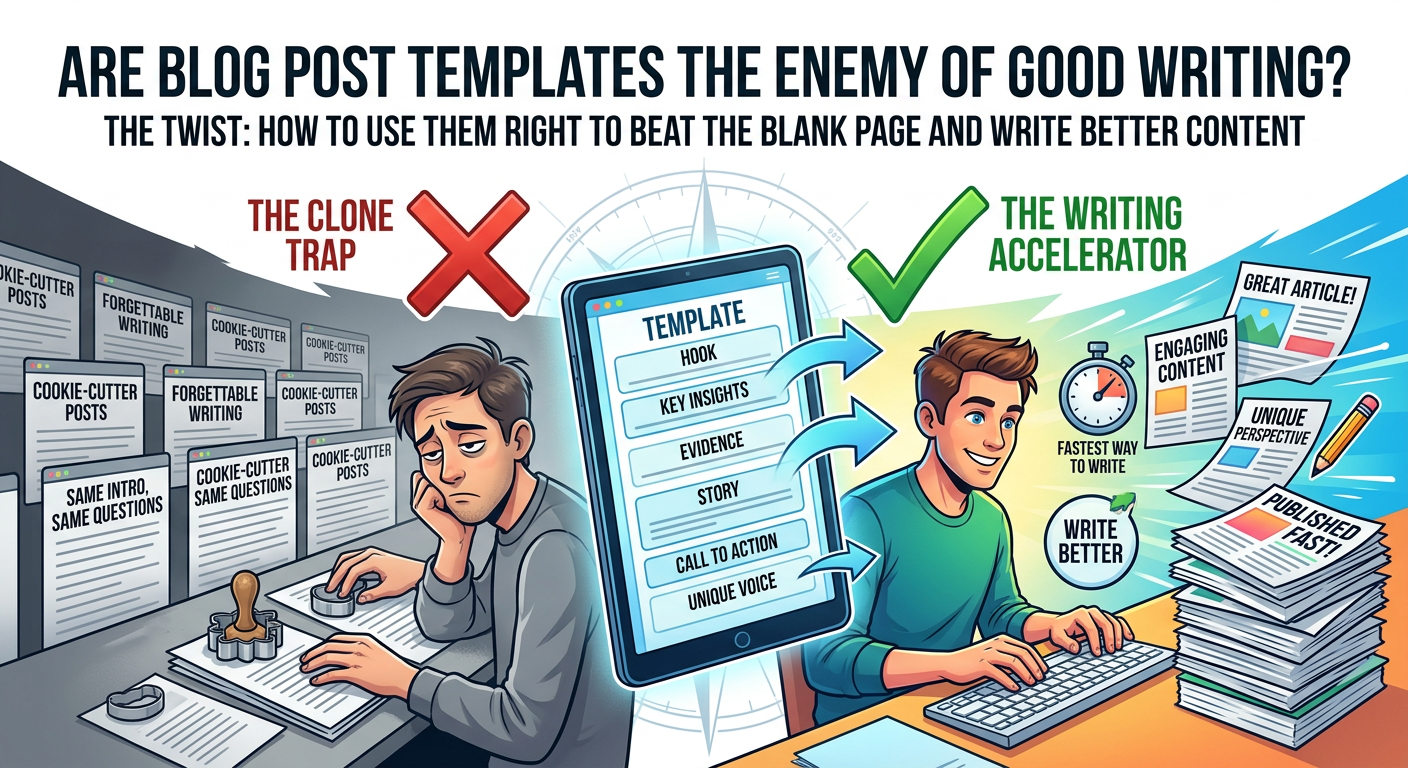
You think a blog post template will make your writing sound like everyone else. You picture cookie-cutter posts: same intro, same fake questions, same weak ending. I get it — I’ve written and edited blog content for the better part of a decade, and I’ve read a thousand of those posts. They’re forgettable. So you decided a blog post template is the enemy of good writing.
Here’s the twist. The template was never the problem. Writers using templates badly are the problem. Used right, a blog post template is the single fastest way to write better, publish more, and beat the blank page. Let me show you why.
Table of Contents
Why the Blank Page Is So Hard to Start
A blank page asks you two questions at once. What do I say? And how do I arrange it?
Your brain can’t do both well at the same time. So it freezes. You rewrite the first line six times. An hour disappears and you have nothing.
This isn’t a talent problem. It’s a focus problem. Your working memory only holds so much at once, and structure eats all of it.
A blog post template solves half the problem for you. It answers “how do I arrange it” before you sit down. Now your whole brain is free for the part that matters: the ideas.
That’s the trade. You give up decisions you never cared about. You get back energy for the decisions you do.
Does a Blog Post Template Kill Your Writing Voice?
No. A blog post template shapes only the structure of your post — the order of your hook, problem, points, and conclusion. Your voice comes from your word choices, examples, opinions, and stories, none of which the template touches. Two writers using the same template still produce completely different posts.
This is the objection I hear most. And it sounds smart. It’s also backwards.
Think about a jazz musician. They play inside a chord structure. The structure doesn’t erase their style. It gives them something to push against.
Or think about a sonnet. Fourteen lines, a fixed rhyme scheme, strict rules. Some of the most personal poems ever written live inside that box. That’s no accident — research reviews on creativity find that limits, not blank freedom, push people toward their best ideas.
Your voice doesn’t come from the shape of the post. It comes from your word choices. Your examples. Your jokes. Your opinions. A blog post template touches none of that.
Here’s a simple test. Take two writers. Give them both the same blog post outline: hook, problem, three tips, conclusion. Their posts will still sound completely different. The template only sets the skeleton. You bring the skin, the muscle, and the face.
What Actually Makes a Blog Post Template Bad
Let me be fair to your fear for a second. Bad template posts are real. You’re not imagining them. But look closely at why they’re bad. It’s almost never the structure. It’s the filler.
The bad posts have:
- Empty intros like “In today’s fast-paced world…”
- Tips that could apply to anything
- No real examples, just vague advice
- A weak ending that trails off with no point
None of that is the template’s fault. That’s a writer with nothing to say, hiding inside a shape. The shape just made the emptiness easier to spot.
Give a person with real ideas the same blog post template. The post comes alive. Same skeleton, totally different result.

How a Blog Post Template Helps You Write Faster
Let’s talk numbers, because this is where skeptics go quiet.
Say a blank-page post takes you four hours. Two of those hours go to structure. Where does this go? What comes next? Does this section belong here?
A blog post template deletes those two hours. You still spend two hours on the actual writing. But now you finish in two hours instead of four.
When I started timing my own drafts, a template cut my average post from just over four hours to a little under two. That’s not a small win. That’s double your output. It’s the same payoff you get from any good content creation workflow: less time on logistics, more time on ideas.
Over a year, that’s the difference between 25 posts and 50. More posts means more chances to rank, more chances to get shared, more chances to be found. When it comes to content, posting often while keeping quality high beats slow perfection almost every time.
Why Templates Make Editing a Blog Post Easier
Here’s a benefit almost nobody talks about. A blog post template doesn’t just help you write. It helps you fix.
When every post follows a clear shape, you spot problems fast. Missing hook? Obvious. No example in section two? Obvious. Conclusion with no call to action? Obvious.
Without a template, editing is a fog. You feel like something is off, but you can’t name it. So you push words around and hope.
With a blog post template, editing becomes a checklist. You’re not guessing anymore. You’re checking boxes. A slow, painful edit turns into a quick, calm pass.
Why Your Content Team Needs a Blog Post Template
Maybe you write alone today. But content rarely stays a solo job.
The day you hire a writer, or work with an editor, or hand a draft to a client, structure stops being optional. It becomes the shared language that keeps everyone sane.
A blog post template means:
- New writers ramp up in days, not months
- Editors know exactly what to look for
- Clients get a predictable, professional result
- Nobody reinvents the wheel on every post
Try scaling content without a template. You get chaos. Ten writers, ten random shapes, no consistency, endless rework. The template is the thing that lets good writing survive more than one person.
How Blog Post Structure Improves Your SEO
Let me hit the part your inner skeptic thinks is hype. Then I’ll prove it isn’t.
Search engines don’t “love templates.” That would be silly. But they do reward the things good blog post structure forces you to do:
- Clear headings
- A logical flow
- Sections that answer real questions
- Scannable lists
- A direct answer near the top
A good blog post template bakes all of that in by default. You’re not doing SEO tricks — you’re just applying practical blog SEO the boring, reliable way. You’re following a shape that matches how people and search engines both read.
The result is posts that are easier to skim, easier to rank, and easier to feature in those answer boxes at the top of results. Not because you gamed anything. Because structure and clarity go together. Structure gets you read; showing the kind of real experience Google trusts is what gets you ranked.
Do Experienced Writers Still Need a Blog Post Template?
This one stings a little, so let me meet it head on.
The best writers I know use templates the most. Not because they can’t write without one. Because they respect their own time.
An expert chef still preps their station the same way every night. A pilot with 20 years still runs the checklist before every flight. Experience doesn’t remove the value of a system. It reveals it.
A blog post template isn’t training wheels. It’s a race car’s setup routine. Pros use structure to go faster and make fewer mistakes — not to cover for weak skill.
If anything, a beginner can get away without one. A pro who wants to publish often, at a high level, needs a template more, not less.
How to Use a Blog Post Template Without Sounding Generic
Fine, you say. Say I try it. How do I avoid the soulless version?
Simple. The template is a container, not a script. Start from a proven blog post template structure, then fill it with specific, real, and yours.
Here’s the rule I live by:
- The template picks the sections
- You pick every single word
- Every section gets one real example, number, or story
- If a section feels empty, you don’t have the idea yet — so dig deeper
Do that, and the shape disappears. Readers never notice the template. They only notice that your post is clear, useful, and easy to read — the whole idea behind what Google calls helpful, people-first content.
The generic posts you hate skipped that rule. They kept the container and forgot to fill it. That’s a discipline failure, not a template failure. The same warning applies if you draft with AI: even the best AI tools for bloggers only fill the container faster — you still have to supply the substance.
The Real Reason Writers Avoid Templates
Let me say the quiet part out loud. The real reason people avoid templates is fear.
There’s a romantic idea that real writers pull genius from thin air. That structure is for people who lack talent. That a true artist needs no plan.
It feels good to believe that. It also keeps you stuck.
Here’s what writers actually feel when they use a good blog post template. Relief. Freedom. Flow. The dread of the blank page is gone. The energy you wasted on “where does this go” now goes into ideas.
Writing stops feeling like a fight. It starts feeling like a craft you control. A template doesn’t cage your creativity. It protects it. It clears the busywork so the real work can breathe.
Try a Blog Post Template on Your Next Post
So here’s where you landed. You were scared a blog post template would flatten you into everyone else. It won’t. The template handles the skeleton. You still bring the voice, the ideas, the jokes, the opinions — all the stuff people actually remember. What you give up is the two hours of “where does this go” panic you never wanted anyway.
I’ll put my name on that, because I’ve lived both versions — the four-hour blank-page grind and the two-hour template draft. The writers who sneer at templates aren’t guarding their craft. They’re working twice as hard for worse results and calling it principle. You don’t have to join them.
Grab one blog post template right now and use it on your very next post. Fill every section with something real — a number, a story, an example only you could give. Write that one post the template way, then decide for yourself. My money says you never crawl back to the blank page again.