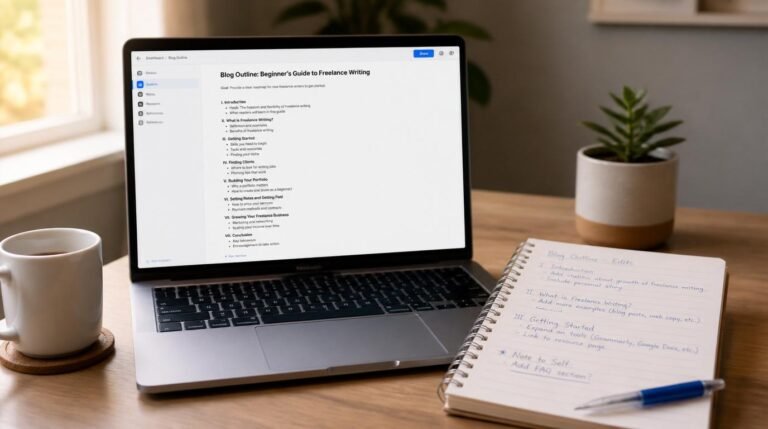

How to Use ChatGPT for Blog Research Without Losing Your Voice

You want to use ChatGPT for blog research, but you’re scared it’ll flatten your writing into slop. You’ve seen that slop—bland blog posts that sound like a robot in a suit. Zero personality. Zero soul. You promised yourself you’d never write like that, so you decided ChatGPT wasn’t for you. Fair enough. But you were right to reject the wrong way to use it, and wrong to throw out the whole tool. There’s a way to use ChatGPT for blog research that never touches your voice. Not once. Let me show you why.
How do you use ChatGPT for blog research without losing your voice? To use ChatGPT for blog research without losing your voice, keep it on one side of a hard line: use it only before you write, never instead of writing. Let it brainstorm angles, poke holes in your outline, and organize notes—then verify every fact and write every sentence yourself.
Table of Contents
The Mistake That Makes ChatGPT Kill Your Voice
Here’s the trap almost everyone falls into. They open ChatGPT and type: “Write me a blog post about X.” Then they hit publish on whatever comes back.
That’s the problem. That’s the slop.

But “write me a post” and “help me research this post” are two completely different jobs. One replaces you. The other assists you.
The people who lose their voice let the machine draft their sentences. Of course their voice dies. They stopped writing.
You’re not going to do that. You’re going to use ChatGPT for blog research before you write, not instead of writing.
Why Your Writing Voice Lives in the Draft, Not the Research
Think about where your voice actually comes from. It’s not in the facts you gather. It’s in how you say things. Your rhythm. Your jokes. The weird metaphor only you would reach for. The way you start a paragraph with one blunt word.
None of that happens during research. Research is the boring part. It’s finding the stats, checking the angle, listing the questions.
Your voice shows up later. It shows up when your fingers hit the keys and you decide how to phrase the idea.
So if you only use ChatGPT for the boring part, your voice never enters the room. It can’t be stolen from a room it’s not in. That’s the whole secret. Keep the tool on one side of the line. Keep your writing on the other.
What ChatGPT Is Good At for Blog Research
Let’s get specific. Here are the research jobs ChatGPT does well. None of them involve writing your prose.
- Brainstorming angles. You have a topic. Ask for 20 possible angles. Throw out 19. Keep the one that sparks something in you.
- Finding the gaps. Paste your outline. Ask: “What am I missing? What would a smart critic say I skipped?”
- Making question lists. Writing an interview post? Ask for 15 sharp questions. Pick your favorites. Rewrite them in your words.
- Summarizing your own sources. Drop in a long report you already trust. Ask for the key points. You read faster.
- Arguing the other side. Ask it to attack your point. Now you know which objections to answer in your post.
- Organizing messy notes. You brain-dumped 800 words of chaos. Ask it to sort them into buckets. You still write every sentence.
See the pattern? Every task feeds your thinking. Not one produces the final text. You stay the writer. ChatGPT stays the assistant that fetches things—one of the best AI tools for bloggers when you keep it in a supporting role.
The One Rule That Protects Your Writing Voice
Here’s the single rule that protects your voice. Ready?
Never paste its sentences into your post.
That’s it. That’s the line.
You can read what it writes. You can steal an idea from it. You can let it point you somewhere. But the words that land on the page must be yours. Every time. No exceptions.
Think of it like a research assistant handing you a folder. You read the folder. Then you close it and write in your own hand.
The moment you copy-paste its paragraph, you’ve swapped your voice for its voice. That’s the exact thing you were scared of. So just don’t do it.
This one habit is the whole game. Master it and you can use ChatGPT for blog research every single day. Your readers will never hear the machine.
A Step-by-Step ChatGPT Blog Research Workflow
Let me walk you through a real example. I’ve built this into my regular content creation workflow and run some version of it on nearly every post I’ve published for years—and not one reader has ever told me a piece sounded like a bot. Say I’m writing a post about cold brew coffee.

Step one: I dump my raw thoughts. I open a blank doc, not ChatGPT. I write everything I already believe about cold brew. Messy. Personal. Mine.
Step two: I ask ChatGPT to poke holes. I paste my messy notes. I ask: “What claims here need a source? What am I assuming?” It flags three claims. Good. Now I know what to check.
Step three: I verify the facts myself. I look up the real numbers on brew time and caffeine. I do not trust ChatGPT for the stats. More on that in a second.
Step four: I ask for angles I missed. It suggests writing about cold brew and cost savings. I hadn’t thought of that. Nice. I add a section.
Step five: I write the whole post myself. From scratch. In my voice. Using what I learned, not what it typed.
Notice something. ChatGPT touched steps two and four. It never wrote a word of the post. That’s how you use ChatGPT for blog research and keep every ounce of your voice.
Prefer to watch the workflow instead of read it? This walkthrough breaks down a full ChatGPT blogging process step by step—a useful companion to the research-only method above, as long as you keep the actual writing yours.
The ChatGPT Hallucination Problem (And Why It Won’t Sink You)
Let me be straight with you. ChatGPT makes stuff up. It states fake facts with total confidence. This is real, and it’s a big deal. OpenAI’s own research admits that even its newest models still hallucinate, and it prints a warning right under the chat box: ChatGPT can make mistakes.
If you asked it for a study and pasted that “study” into your post, you’d be publishing fiction. That would wreck your credibility.
But look at the workflow above. I never used it as a source. I used it as a thinking partner. The facts came from real places I checked myself. ChatGPT just helped me figure out which facts to go find.
So ChatGPT hallucinations aren’t a reason to quit. They’re a reason to keep the tool in its lane. Ideas and structure? Fine. Hard facts and quotes? Verify every single one.
Treat it like a clever friend who’s often wrong about details. You’d take their brainstorm. You wouldn’t take their word on a number.
Why Using ChatGPT for Research Makes Your Voice Stronger
Here’s the part critics never admit. Used right, this doesn’t weaken your voice. It frees it up.
Think about where your energy goes on a normal writing day. A huge chunk gets burned on grunt work. Sorting notes. Hunting for the right angle. Fighting the blank page.
That grunt work leaves you tired. And a tired writer writes flat sentences. Your best voice needs fresh energy.
When ChatGPT handles the grunt work, you arrive at the draft with a full tank. You’ve got structure. You’ve got your angle. Now you get to do the fun part.

The fun part is the voice part. The phrasing. The jokes. The rhythm. That’s where you want your energy going.
So the tool doesn’t replace the human parts. It makes room for them. It takes the chores so you can do the art. That’s what fans of AI writing tools get—and critics miss. The right kind of help makes the human parts louder, not quieter.
It’s also what search engines reward. Google’s guidance on creating helpful, people-first content pushes for original writing with real experience behind it—exactly the stuff only you can produce. Protect that, and the blog SEO basics get a whole lot easier.
The Real Fear Behind ChatGPT Writing Skepticism
Let’s name the real fear. You’re not scared of a tool. You’re scared of becoming generic.
You built a voice over years. It’s how readers know it’s you. Losing that would feel like losing yourself. That fear is smart. Respect it.
But the fear points at the wrong villain. The villain isn’t ChatGPT. The villain is letting any tool do the part that makes you you.
Think about a calculator. It doesn’t make you bad at math. It just makes you faster. You still have to know what the numbers mean. A research tool works the same way. It won’t make you generic—not if you still write every sentence yourself.
Keep the writing. Delegate the digging. Your voice was never in the digging anyway.
7 Rules for Using ChatGPT for Blog Research
Let me boil it all down. Here are the rules that keep your voice safe every time.
- Use it before you write, never instead of writing. Research phase only.
- Never paste its sentences into your post. Read, learn, then write in your own words.
- Verify every fact yourself. It hallucinates. Sources come from the real world.
- Feed it your own notes. The more of you goes in, the more useful it gets.
- Use it to poke holes, not fill them. Let it question your thinking. You do the answering.
- Draft with the tool closed. When it’s time to write, put it away completely.
- Read your draft out loud. If a line doesn’t sound like you, cut it. Your ear is the final judge.
Follow these and the machine stays invisible. Your readers hear one voice. Yours.
ChatGPT Doesn’t Steal Voices—Lazy Habits Do
ChatGPT doesn’t steal voices. Lazy habits do. The writers who went generic handed over the writing itself—and then blamed the tool. You’re smarter than that.
You’ll hand over the chores instead: the note-sorting, the angle-hunting, the blank-page dread. That’s what ChatGPT for blog research is for. Let it carry the boring half. Then close the tab, clear your head, and write every sentence like only you can.
So do this. Pick the next post on your list. Open ChatGPT for the research phase only—brainstorm angles, poke holes in your outline, verify every fact—and don’t type one word of prose into it. Digging on one side. Writing on the other. Try it once, and you’ll stop fearing the tool for good.
Recommended Reads to Sharpen Your Writing Voice
Disclosure: The links below are affiliate links. If you buy through them, DailyNetBlog may earn a small commission at no extra cost to you. See the full affiliate disclosure.
ChatGPT can carry the research. These three books help you build the part it can’t touch—your voice.
- On Writing: A Memoir of the Craft — Stephen King. The definitive book on writing sentences that sound like a human. King’s brutal rules for cutting the fluff are exactly what keeps your drafts from ever reading like a robot in a suit.
- Everybody Writes (2nd Edition) — Ann Handley. A practical playbook built for blog and content writing, with a whole section on building a brand voice—perfect for the blogger who wants ChatGPT for research but words that are unmistakably theirs.
- Bird by Bird — Anne Lamott. Her “shitty first drafts” philosophy frees you to brain-dump before you polish—the exact first step in the workflow above, minus the blank-page dread.
Frequently Asked Questions
Can I use ChatGPT for blog research without hurting my SEO?
Yes. Google rewards original, people-first content, and ChatGPT for blog research never touches your published words—it only helps you brainstorm angles, spot gaps, and organize notes before you write. As long as you write every sentence yourself, your rankings are safe.
Does using ChatGPT for research count as AI-generated content?
No. If ChatGPT only questions your outline or sorts your notes and you write the prose from scratch, the finished post is human-written. Google’s concern is with low-value, mass-produced pages, not with tools you use behind the scenes.
Will Google penalize my blog for using ChatGPT?
Google doesn’t penalize AI use on its own—it targets unhelpful, spammy content no matter how it’s made. A post you research with ChatGPT and write in your own voice is exactly the kind of helpful content Google wants to rank.
How do I stop ChatGPT from flattening my writing voice?
Follow one rule: never paste its sentences into your draft. Use it before you write, not instead of writing, and close the tab completely when it’s time to draft. Your voice lives in the writing, so keep the writing yours.
Can I trust ChatGPT for facts and statistics?
No. ChatGPT hallucinates—it states false facts with total confidence, something OpenAI’s own researchers admit. Use it to figure out which claims to check, then verify every number and quote against a real, primary source before you publish.